|
The Brave New Business Journal
|
|
Issue 07 · Tuesday, 16 June 2026 · Reading time: 5 minutes
|
|
Hello,
|
|
It’s 16 June, and your whole feed just became a Middle East desk. Over the
weekend the US and Iran announced a peace deal: on paper the Strait of
Hormuz reopens on signing this Friday, the US blockade lifts, and oil
already fell 4 to 5%. After fifteen weeks of the war repricing your
freight, fuel and inflation, that’s real news.
|
|
Here’s the thing. Everyone will post the obvious take, ‘great, costs come
down.’ That’s not how you stand out. The supply chain leaders who get
noticed this week are the ones who read it sharper than the room, and who
turn it into a move on their own desk instead of a hot take.
|
|
So this issue is built for exactly that: five posts you can steal, three
ideas to bring to the table that position you from strength, and one
structural read most people will miss. All actionable. None of it punditry.
|
|
|
|
|
|
|
|
01 · THIS WEEK’S POSTS
|
|
Five posts you can steal
|
|
1. Call it what it
actually is. “Everyone’s posting that the war is over.
Let’s be precise about what was signed. Not peace. A 60-day ceasefire, and
it isn’t even inked until Friday. The strait reopens ‘under Iranian
arrangements,’ nuclear and sanctions are parked, and Israel is still
striking in Lebanon. I’m glad it’s happening. But I’m planning the pause,
not the peace. In this job, reading the fine print is the job.”
|
|
Friend:
“Everyone says the war’s over. It’s a 60-day
ceasefire that isn’t even signed till Friday. I’ll believe the clean
version when I see it.”
|
|
2. Point at what no
one’s watching. “The headline is oil. The supply chain
story is the 30-day surge that comes next. When the strait reopens, the
capacity trapped in the Gulf and the cargo rerouted around the Cape all
unwind at once. Rates spike on the rush, then drop, schedules scramble, and
the inventory you front-loaded collides with cargo that’s suddenly moving
again. Watch the reopening, not the ceasefire.”
|
|
Friend:
“Everyone’s watching oil. The real mess is
the month after the strait reopens, when everything stuck moves at
once.”
|
|
3. Hold the carriers
to their own word. “Carriers introduced the war surcharges
in days and called them ‘emergency’ and ‘temporary,’ in writing. The
emergency is resolving and oil is down 4 to 5%. Here’s the test of whether
a ‘fuel’ surcharge is about fuel: it moves down when fuel does. Pull your
last three invoices, split the bunker and war-risk lines off base rate, and
ask your carrier, in writing, when each comes off. The deal is your
opening. Use it before everyone forgets.”
|
|
Friend:
“Carriers swore the war charges were
temporary. The war’s ending. Time to make them prove it.”
|
|
4. Be the calm
one. “The deal dropped, oil fell, futures jumped, and half
my feed called the all-clear. I’m glad it’s happening. I’m also not
rebuilding my H2 plan on it yet. It isn’t signed until Friday, Israel isn’t
a party, Iran says it’ll keep control of the strait and charge ‘service
fees,’ and the hard issues are deferred 60 days. The market repriced in an
afternoon. Supply chains don’t. Hold the plan, take the giveback, keep the
contingency routing live until the ink is dry.”
|
|
Friend:
“Everyone’s saying we’re fine now. Maybe.
It’s not signed till Friday and Iran’s already arguing about the toll. I’m
not changing the plan on a tweet.”
|
|
5. Speak from the
chair, not the panel. “Today everyone’s a Middle East
analyst. I’ll leave the geopolitics to them. From the operator’s chair,
here’s what the deal changes on my desk this week. One: I re-rate three
lanes while oil’s down, before the carrier updates its benchmarks. Two: I
pull forward nothing, June was already borrowed demand. Three: I send the
surcharge-rollback letter while the cause is visibly going away. The news
is the headline. The edge is what you do with it on Monday.”
|
|
Friend:
“Everyone’s playing war analyst. I just care
what it does to my freight. Re-rate the lanes, don’t stockpile into a shaky
truce, and make the carriers drop the surcharges.”
|
|
|
|
|
|
|
|
02 · BRING TO THE TABLE
|
|
Three ideas to bring to the table
|
|
1. Claw the war
surcharges back, now. The deal removes the cause, and
oil’s down 4 to 5%. Don’t wait for carriers to volunteer the giveback.
Split bunker and war-risk into separate lines on your last three invoices,
send a written rollback request tied to the falling oil price, and put a
date on it. You become the one who recovered margin while everyone else
celebrated.
|
|
2. Hold the plan.
Don’t whipsaw. It’s a 60-day ceasefire, not peace, and it
isn’t signed until Friday. The strong move is the steady one: keep your H2
plan and contingency routing live until the strait is actually moving
cargo. Calm reads as authority when everyone else is reacting.
|
|
3. Get ahead of the
reopening surge. When Hormuz reopens, trapped Gulf
capacity and the Cape reroutes unwind in a 30-day rush. Pre-book priority
cargo now, expect a rate spike then a drop, and brief your team that
‘reopening’ means turbulence before calm. The exec who saw the whiplash
coming runs the conversation.
|
|
Sources: AP, CNBC, NYT, ISW, 14 June 2026; Reuters, 10 June; FreightWaves.
|
|
|
|
|
|
|
|
03 · THE STRUCTURAL READ
|
|
The read most people will miss
|
|
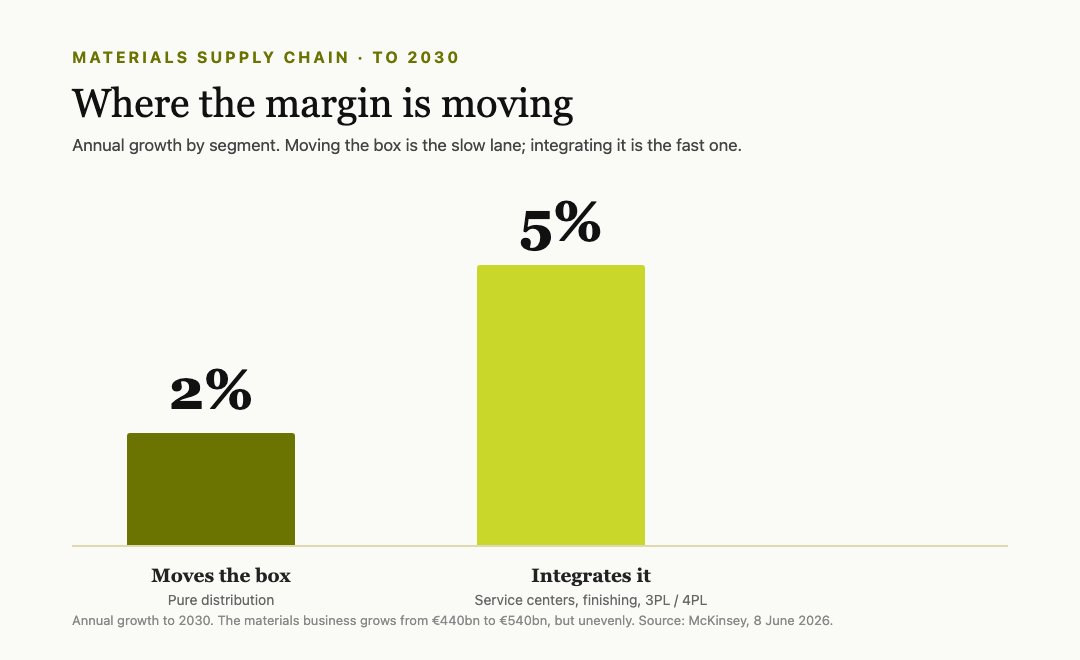
While everyone debates the strait, the bigger shift is quieter. McKinsey (8
June): the margin in the materials supply chain is moving to the middle.
The materials business grows from €440bn to €540bn by 2030, but unevenly.
Pure distribution grows about 2% a year while service centers, finishing
and 3PL/4PL grow 4 to 5%.
|
|
|
The read: being the cheapest mover of a commodity is now the worst seat at
the table. Margin goes to whoever integrates. Bring this to your next
strategy meeting and you’re the one talking about where the business is
going, not just what happened this weekend.
|
|
Room-winner:
“Distribution that moves the box grows at 2%. Distribution that
integrates it grows at 5%. Which business are we in?”
|
|
|
|
|
|
|
|
The Brave New lever
|
|
This issue handed you the words for one week. The leaders who own their
category sound like this every week, on purpose, with a strategy
underneath.
|
|
That’s what Brave New builds. We turn the experts already inside your
organisation into the voices your market listens to: championship business
influencers grown from within, not rented from outside. We use creative
intelligence to find the one position only you can win, and make you the
name that comes to mind when your category is in play.
|
|
Want to see where you
stand? Reply with ‘I want my brand’s audit’ and we’ll
schedule your free 30-minute session.
|

|
Anne BecheruFounder,
Brave New Media
|
|