|
The Brave New Business Journal
|
|
Issue 14 · Tuesday, 4 August 2026 · Reading time: 13 minutes, or 4 if you skip to
the news
|
|
Never make a buyer admit he was wrong
|
|
Deals rarely fall apart because a fact was missing. They fall apart because
somebody stopped listening.
|
|
Hello,
|
|
Last Tuesday we wrote about word order. Answer first, reasons after. That fixes what you
say. It does nothing about the other half of the problem: the person you are saying
it to. Deals rarely fall apart because a fact was missing. They fall apart because
somebody stopped listening. After that moment, nothing you say counts.
|
|
Charles Duhigg, a Pulitzer-winning journalist, spent years studying why some people
connect where everyone else fails. He wrote it up in a book called
Supercommunicators. We pulled out the ten ideas that matter if your week
contains tenders, rate negotiations, contractor reviews and partner calls. For each
one: what it means, what to do, and a line you could actually say.
|
|
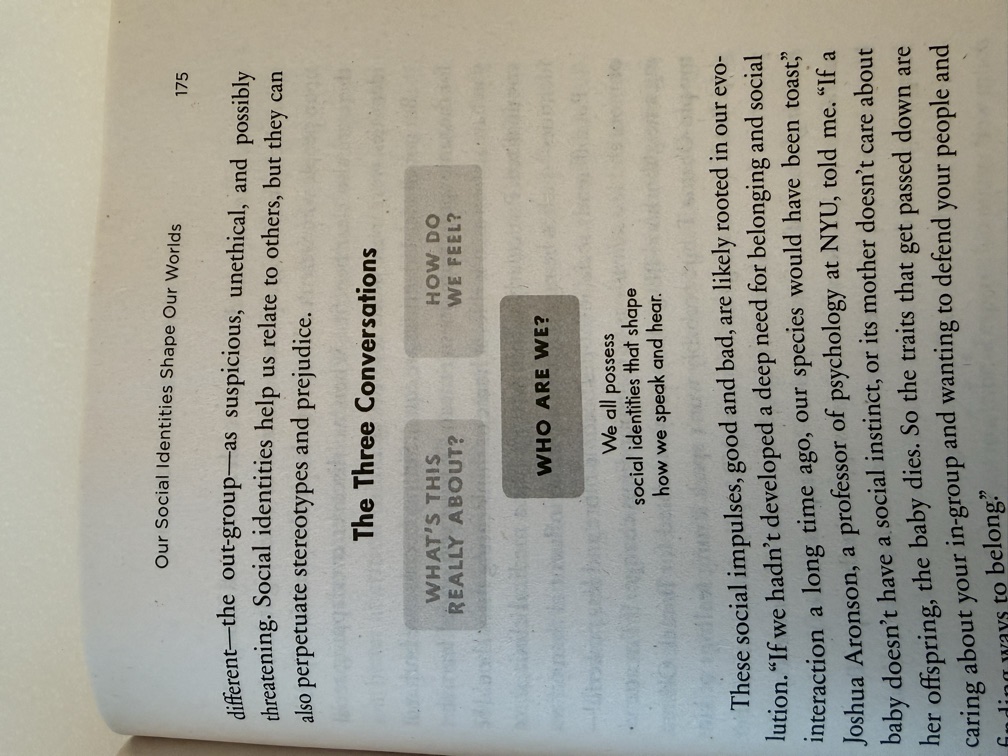
The spine of the whole book fits on one page. Every conversation is really one of
three: what’s this about, how do we feel, or who are we. Most failed meetings are
two people having two different conversations at the same time.
|
|
|
The three conversations, photographed from our copy of the book. Page 175. Yes, we
read it on paper.
|
|
|
|
01 · Part one: when you need someone to say yes
|
|
|
|
1. Facts do not persuade someone who feels judged
|
|
Jay Rosenbloom is a children’s doctor. For years he lost conversations with parents
who did not want to vaccinate their kids. The more he leaned on his authority, the
more they dug in. What worked was the opposite: ask questions, treat the parent as
competent, talk parent to parent before doctor to patient.
|
|
Same thing with the buyer who will not leave their current supplier. They are not
missing your data sheet. They chose that supplier. They defended that choice to
their boss. Maybe they signed it off. Every extra certificate you send makes their
old decision look worse. So every extra certificate makes it harder for them to say
yes to you.
|
|
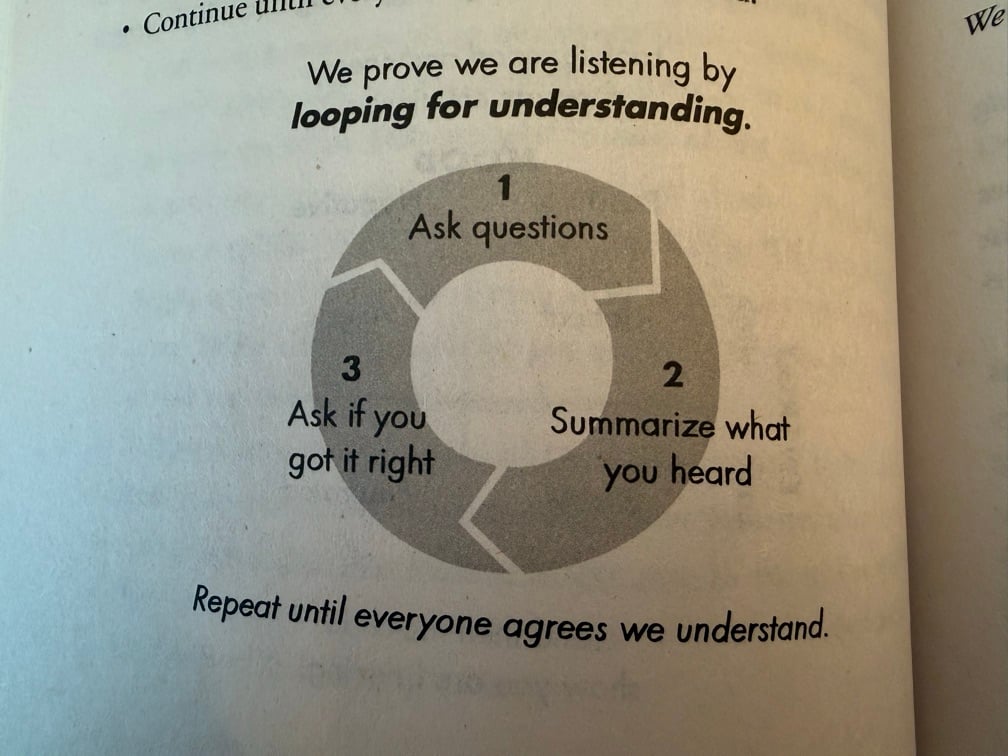
One habit goes with the questions. When they answer, prove you listened: say back
what you heard in your own words, then ask if you got it right. The book calls it
looping for understanding. Three steps, works in any language.
|
|
|
The looping wheel from the book: ask, summarize, check. The whole technique, one
wheel.
|
|
Do this: in your
next pitch meeting, ask two questions about how their operation runs before you
show anything.
|
|
Say it like
this: “You’ve run this line for six years, so you know it better
than I ever will. What’s the one thing you’d change about how it works
today?”
|
|
|
2. Never make agreeing with you feel like admitting failure
|
|
Duhigg says it directly: “You’ll never succeed at getting someone to change
their behavior if, as a prerequisite, you force them to say: Everything I’ve
believed until now is wrong.”
|
|
This is the whole game in a rebid. If your pitch says the current setup is a mess,
the person who built that setup has to admit a mistake in front of their colleagues
before they can sign with you. Most people will keep a mediocre supplier instead.
So tell the story differently: their old decision was right at the time, and yours
is right for what has changed. Volumes changed. Fuel changed. Lead times changed.
Nobody was wrong.
|
|
Do this: before your
next rebid pitch, write one sentence that says why their old choice made sense back
then. Open with it.
|
|
Say it like
this: “The setup you built made sense for the volumes you had then.
What we’d do differently is only about what’s changed since.”
|
|
|
3. Say what you have in common before you say where you disagree
|
|
From the book: “When we discover overlapping social identities, we’re more
prone to connect.” A social identity is a group you feel part of: your
profession, your site, your city, being a parent.
|
|
Find the group you and the other person both belong to, and open the meeting with
it, before the numbers come out. This is different from small talk. Small talk
fills time; this sets what the meeting is about. In a hard review with a carrier,
the shared group is easy to find: you are both operations people, and you both get
the phone call when a truck does not arrive. Start there, and the numbers become a
shared problem instead of an accusation.
|
|
Do this: before your
next tense meeting, write down one thing you and the other side have in common.
Open with it.
|
|
Say it like
this: “Before we open the numbers: you and I both get the call when
a truck doesn’t show. I’d like us to leave here with something that stops
that call for both of us.”
|
|
|
|
|
02 · Part two: the people you work with all year
|
|
|
|
4. Never make one person speak for their whole department
|
|
Duhigg tells the story of Netflix, which learned this the hard way: the moment
people feel put in a box, they defend themselves. Psychologists call it identity
threat. It happens in under a second, and the person will not tell you it happened.
|
|
The everyday version is asking “so what does procurement think?” to the only
procurement person in the room. In that second they stop being a colleague with a
view on this contract and become a spokesperson. You get the safe official answer,
which is worth nothing. Same when you say “you logistics guys always”, or ask the
one supplier at the table what suppliers want.
|
|
Do this: ask people
by name for their own view. Then ask a second person the same question, so nobody
is answering for a whole group alone.
|
|
Say it like
this: “Ana, what’s your read on this one?” Then: “Marek, same
question.”
|
|
|
5. Ask about the parts of people you cannot see
|
|
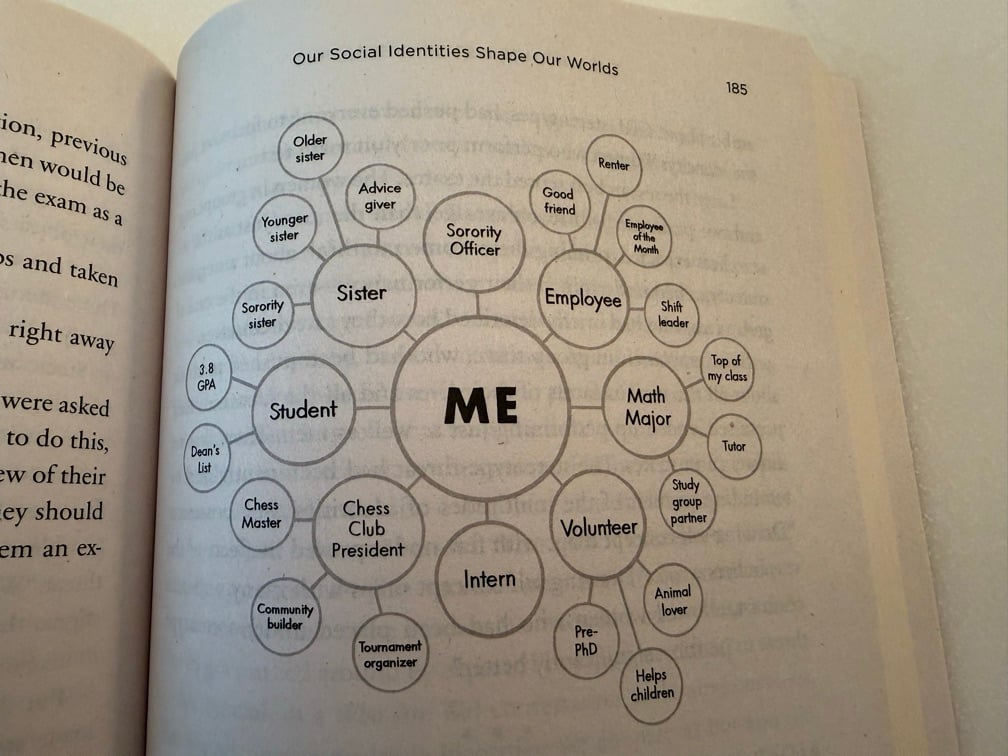
Duhigg again: “We all contain multitudes that are just waiting to be
expressed.” A psychologist named Claude Steele proved the cost of ignoring
this. When a person feels reduced to one label, they perform worse and listen
worse. When you remind them they are more than the label, both improve.
|
|
You have people on site who are only ever “the agency driver” or “the temp on
packing” or “the junior planner”. Treat them as one label and they give you exactly
what the label requires, nothing more. Ask what they did before. The forklift
operator who spent ten years rebuilding engines has opinions about your maintenance
schedule. Right now, nobody is hearing them.
|
|
|
Page 185. One person, twenty identities. Everyone on your site has a map like this.
|
|
Do this: this week,
ask one person on your site what they did before this job.
|
|
Say it like
this: “What did you do before this? I’m asking because people who’ve
worked somewhere else usually notice things here that the rest of us stopped
seeing.”
|
|
|
6. Fix a strained partnership with a project, not a dinner
|
|
Salma Mousa, a political scientist, ran a football league in Qaraqosh, Iraq, after
the war there. Christian and Muslim players stopped seeing enemies once the teams
were mixed and winning required cooperation. What changed them was shared work, not
conversation.
|
|
Think of the 3PL relationship that has gone cold, where the quarterly review is now
an exchange of blame. (A 3PL is a logistics company that runs warehousing or
transport for you.) A dinner will not fix it, because nothing depends on the
dinner. A joint project where neither side can succeed alone will. One lane. One
shared number. Both planners on the same weekly call. Fixed period. People who have
won something together stop blaming each other.
|
|
Do this: pick your
most strained partner and propose one small joint project with one shared target.
|
|
Say it like
this: “Let’s take the Rotterdam lane for eight weeks. One number,
on-time in full, your planner and mine on the same call every Tuesday.
Whatever we learn, we apply to the rest of the contract.”
|
|
|
|
|
03 · Part three: the conversation you are dreading
|
|
|
|
7. Write down how you want it to go before you walk in
|
|
Duhigg’s advice is modest on purpose: “The goal of this exercise is to nudge
yourself to think about how you hope a conversation will unfold, and what you hope
will be said.”
|
|
Before the price increase call, the escalation after a missed delivery, or the
meeting where you tell a contractor their crew is not good enough: take ten minutes
and a piece of paper. Most people only prepare their arguments. That is preparation
for a fight. Preparing what you hope the other person will say is what keeps you
from steamrolling them in the first four minutes.
|
|
Do this: write three
lines before the meeting. What I need them to hear. What I hope they tell me. What
must be true when we walk out.
|
|
|
|
8. Say out loud that this will be uncomfortable, and agree the rules first
|
|
Duhigg’s guide for hard discussions has a fixed order: agree how the conversation
will run, name the discomfort openly, make sure everyone speaks. Netflix turned
this into a company rule: talk about hard things “without blame or shame.”
|
|
Spend the first two minutes of a supplier failure review on the rules, not the
failure. Say the next hour may be awkward. Say today is about the cause, not the
person. Then get the quiet people talking. The person who knows what actually
happened is usually the most junior one in the room, and they will never volunteer
it.
|
|
Do this: open your
next difficult review with two rules, and go first yourself.
|
|
Say it like
this: “This next hour might be uncomfortable, and that’s fine. Two
rules: we’re after the cause, not the person, and everyone here says
something before we finish. I’ll start.”
|
|
|
9. Talk about what happened to you, not what “people like them” always do
|
|
People listen to what happened to you. They argue with claims about their whole
industry. And you cannot reach an understanding with someone while they are busy
defending every carrier in Europe.
|
|
“Carriers always overpromise in peak.” “You people never pick up the phone in
August.” Both may be true. Both guarantee the next twenty minutes are about
carriers in general instead of your stopped line. Replace the generalisation with
what happened to you, with a date and a cost. That is harder to argue with and much
harder to take personally.
|
|
Do this: next time
you catch yourself saying “always” or “never”, swap in one dated example with a
number.
|
|
Say it like
this. Not: “Your industry always overcommits in peak.” Instead: “On
the 14th I had two trucks booked and one arrived. My line stopped for six
hours. I want to understand what happened so I know what to plan for in
November.”
|
|
|
10. Have the conversation you keep postponing
|
|
One more line from the book, maybe the most useful one: “Just because we’re
worried about a conversation, that doesn’t mean we ought to avoid it.”
|
|
You have one on your list right now. The partner whose quality has been sliding for
two quarters. The clause you know has to be reopened. The colleague whose emails
you have been avoiding since spring. Waiting is not free. The problem keeps running
while you wait, and when you finally raise it, you raise it angry. That is the
worst version of that conversation. The Harvard Study of Adult Development, which
has followed the same people for decades, reached a simple conclusion: “Good
relationships keep us healthier and happier.” Working relationships included.
|
|
Do this: put the
conversation in your calendar this week, with a name and a time.
|
|
Say it like
this: “Can we take twenty minutes this week? There’s something on
the account I’d rather say to you directly than let it build.”
|
|
|
|
|
04 · Also this week: five things people will bring up
|
|
|
|
You now have ten ways to handle a conversation. Here is what this week’s
conversations will be about. Five things from the news, US and EU, explained
simply. Use them at lunch, in the corridor, or with the customer who likes to talk
markets.
|
|
1. Central banks held their
rates, but the mood changed. On 29 July the US Federal Reserve kept its
key interest rate at 3.5 to 3.75 percent. An interest rate is the price of
borrowing money, and the Fed’s rate sets the tone for loans across the whole
economy. The surprise was the vote: three of the twelve members wanted a raise, the
most disagreement since 2016. In Frankfurt, the European Central Bank also held its
rates on 23 July, and President Lagarde said some governors considered a hike there
too. Both banks decide again in September. And Japan gave the week its drama: the
yen fell to a 40-year low against the dollar, so the US and Japan stepped into the
currency market together to pull it back up, their first joint intervention in 15
years. An intervention means governments buying or selling a currency to move its
price.
|
|
What to say:
“Nobody cut. And the argument has flipped: a year ago they debated when to
cut, now they debate whether to raise.”
|
|
|
2. Prices are rising again on
both sides of the Atlantic. Eurozone inflation reached 2.9 percent in
July, up from 2.8 in June. In the US it was 3.5 percent in June. Inflation is the
speed at which prices rise, and central banks aim for 2 percent. The push comes
almost entirely from energy: energy prices in Europe were 10 percent higher than a
year ago.
|
|
What to say:
“Take out energy and European inflation is close to target. The problem is
oil, not the economy.”
|
|
|
3. Oil just turned. Watch it
this week. For months oil was expensive because the routes were dangerous.
Attacks near the Strait of Hormuz, a narrow sea passage a large share of the
world’s oil sails through, pushed Brent, the main world oil price, above 100
dollars a barrel earlier this year, and American petrol over 4 dollars a gallon.
Then the weekend happened. On Sunday OPEC+, the group of big oil-producing
countries, agreed to pump more in September, its sixth increase in a row. And on
Monday President Trump said talks with Iran are restarting, with a deal to reopen
the strait on the table. Brent dropped about 5 percent in hours, to around 83
dollars. The price no longer moves on how much oil exists. It moves on whether the
diplomacy holds.
|
|
What to say:
“The supply was always there. The moment the routes look safe, the price lets
go. Watch the Hormuz talks, not the wells.”
|
|
|
4. American hiring is cooling
fast. The US added 57,000 jobs in June, about half what economists
expected, and the previous months were revised down. Companies are not firing
people. They have simply almost stopped adding new ones. The next jobs report comes
this Friday, 7 August, and it matters: a weak number argues against rate raises in
September, a strong one argues for them.
|
|
What to say:
“Low hire, low fire. Comfortable if you have a job, brutal if you are looking
for one.”
|
|
|
5. The US-EU tariff deal is
now law, with one fight left. The deal is final since June: most European
goods entering the US pay a 15 percent tariff, which is a tax on imported goods.
Steel and aluminium are the exception. Above certain volumes they still pay 50
percent, and the EU has given the US until 31 December to fix that, or parts of the
deal can be suspended.
|
|
What to say:
“The 15 percent is the stable part. If your product contains steel or
aluminium, the real deadline is 31 December.”
|
|
|
|
|
Before you go
|
|
Two things to think about
|
|
•
|
Think of the last deal you lost. You probably lost it in the moment the other
person stopped listening, not in the moment they said no.
|
|
|
•
|
Nobody has ever been argued into admitting their old decision was bad. People
change when they can keep their pride and change at the same time. Your job
is to build them that exit.
|
|
|
|
|
Two things to ask yourself
|
|
•
|
In my next negotiation, do I know what the other person is protecting? Not
what they want. What they are afraid to lose.
|
|
|
•
|
Which conversation am I postponing right now, and what does every week of
postponing cost?
|
|
|
|
|
One thing to try this week
|
|
Pick one item from today’s ten. Just one. Use it in a real meeting, the script line
is already written for you. Then reply to this email and tell me which one you
picked and what happened. I read every reply.
|
|
|
|
One more thing
|
|
You know someone who runs tenders, reviews suppliers, or has been putting off a
hard conversation with a partner. Forward this email to them. It costs you one
click, it makes their next negotiation easier, and people remember who sends them
useful things.
|
|
And if someone forwarded this to you: welcome. The Journal lands every Tuesday, and
you can get your own copy here.
|
|
|

|
Anne Becheru
Senior Marketing Strategist, Founder of Brave New Media
|
|
|
See you next Tuesday.
|
|
Sources for the curious: Charles Duhigg, Supercommunicators; Claude
Steele on stereotype threat; Salma Mousa’s contact study in Qaraqosh, Iraq;
the Harvard Study of Adult Development. This week’s numbers: Federal Reserve
statement, 29 July; European Central Bank decision, 23 July; Eurostat flash
estimate, 31 July; US Bureau of Labor Statistics, June employment report;
OPEC+ statement, 2 August; oil and currency moves as reported Monday 3
August; Council of the EU, 25 June.
|
|
 Brave New Media


