|
Forwarded this? Subscribe here and get it every Tuesday. |
||||

The Brave New Business Journal
Issue 20 · Tuesday 15 September 2026 · from Anne Becheru
|
||||
|
Tuesday mornings. One idea, one question, one thing to try. |
||||
|
Good morning from San Francisco. Business season is open and I am starting mine at Dreamforce, which means I spent the weekend doing the thing everyone does before a conference and nobody admits to. Rehearsing my own introduction. Out loud. Alone. Changing one word, then changing it back. 
Around the fourth run-through, a question I could not put down. How many times does somebody have to hear this before I become memorable? Not a teenager. If you have a teenage son, or a nephew who has worked out that everything you say is a suggestion, there is no number for that. It is somewhere between four hundred and never, no framework is coming to rescue you, and parent to child we are all on our own. I mean the people I am about to shake hands with. The client. The partner. The person who will try to describe my company to somebody else in three weeks, in a corridor, with me nowhere near the room. There is a real number for them. It is much higher than I would like. |
||||
|
The 3 / 5 / 7 / 9 rule
Kory Marchisotto, CMO of e.l.f. Beauty, put it this way. Three is what they can hold. Five is when it moves from short-term memory into long-term. Seven is when they can recall it. Nine is when they can repeat it to somebody else, in their own words, without you there. Her line:
Everything below is those four numbers, and what each one costs you when you ignore it. 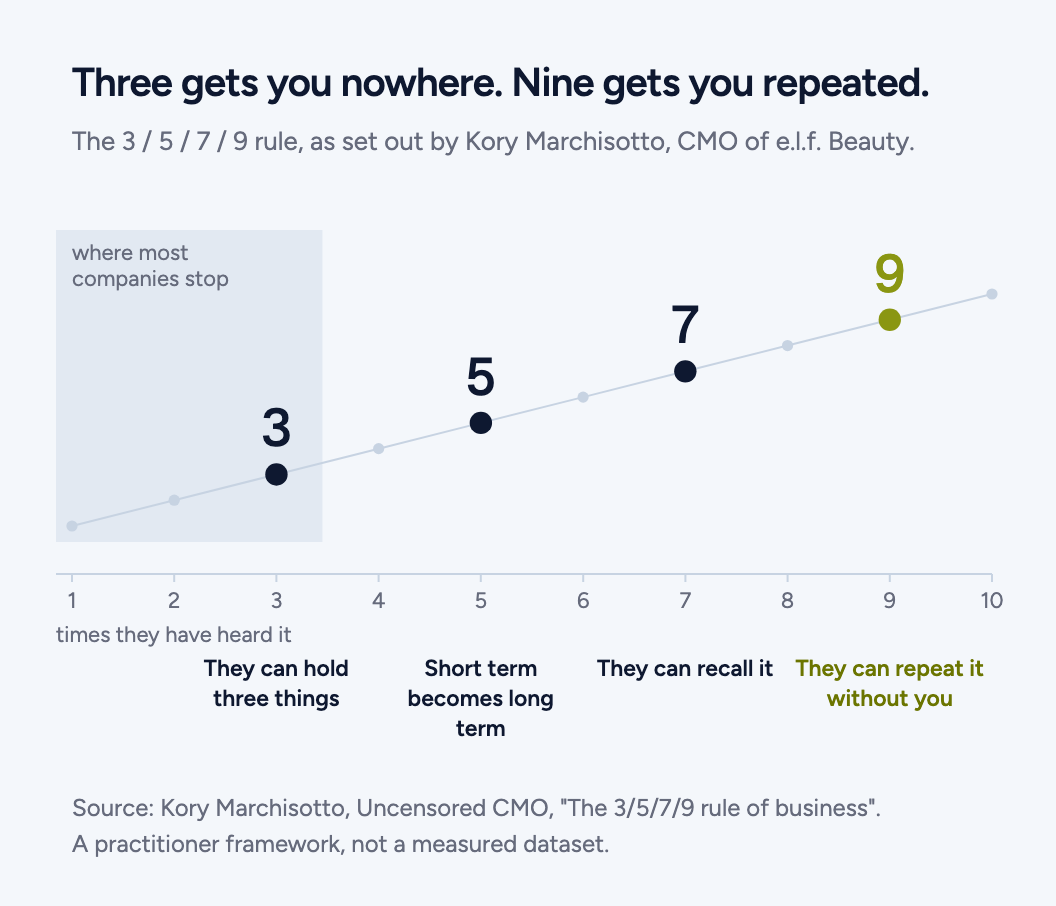
|
||||
|
3
Three: what they can hold
Three things. Decide which three and stop adding. The research is on your side and it is older than your company. Miller’s famous “seven plus or minus two”, from 1956, has been over-read for seventy years. Cowan’s 2001 reassessment, once you strip out rehearsal and grouping, puts the real limit closer to four. So three is conservative. Conservative is correct. What it costs you. Every message you add is a message you are removing. The company with nine differentiators has none, because the listener leaves holding three at most and you did not choose which three. Somebody else did, at random, in a corridor. |
||||
|
5
Five: when it moves
Five repetitions is roughly where something crosses from short-term memory into long-term. Which tells you what is happening below five, and it is not indifference. 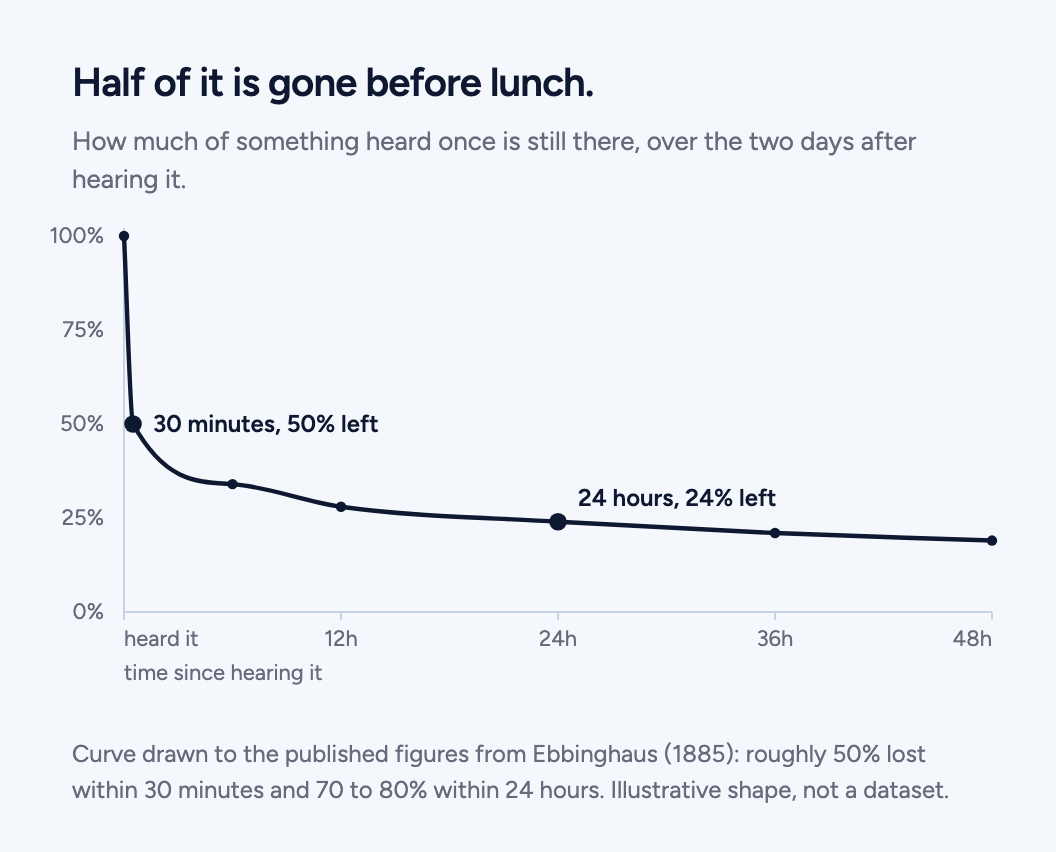
Most of what you said in a meeting today is gone by tomorrow. That is not rudeness. That is memory doing exactly what memory does with something heard once. What it costs you. The all-hands where you explained the strategy beautifully, once. The client presentation everybody loved. Neither survived the week, and you have been operating since on the assumption that they did. |
||||
|
7
Seven: when they can recall it
Seven is roughly where the average person can bring it back unprompted. And here the evidence gets genuinely useful. Hasher, Goldstein and Toppino showed in 1977 that repeating a claim makes people rate it truer, with no new evidence attached at all. It has been replicated for decades. The detail that should change your behaviour: the biggest single jump comes at the second exposure, then the gains slow down. Most of the value arrives early and then accumulates quietly. Which is exactly why quitting at three feels sensible and is a catastrophe. You have paid the expensive part and stopped before the return. What it costs you. The campaign killed after one quarter because “it did not land”. It landed. Nobody was there for the other four exposures. |
||||
|
||||
|
The part the rule leaves out
Nine times in one meeting does nothing. Ebbinghaus measured this in 1885, and Cepeda’s 2006 meta-analysis, 839 assessments across 317 experiments, confirmed it: the same exposure spread out beats the same exposure crammed, in almost every domain tested. Crammed repetition makes something feel familiar, and familiarity decays. Spaced repetition makes it stick, because partial forgetting forces the brain to re-encode. 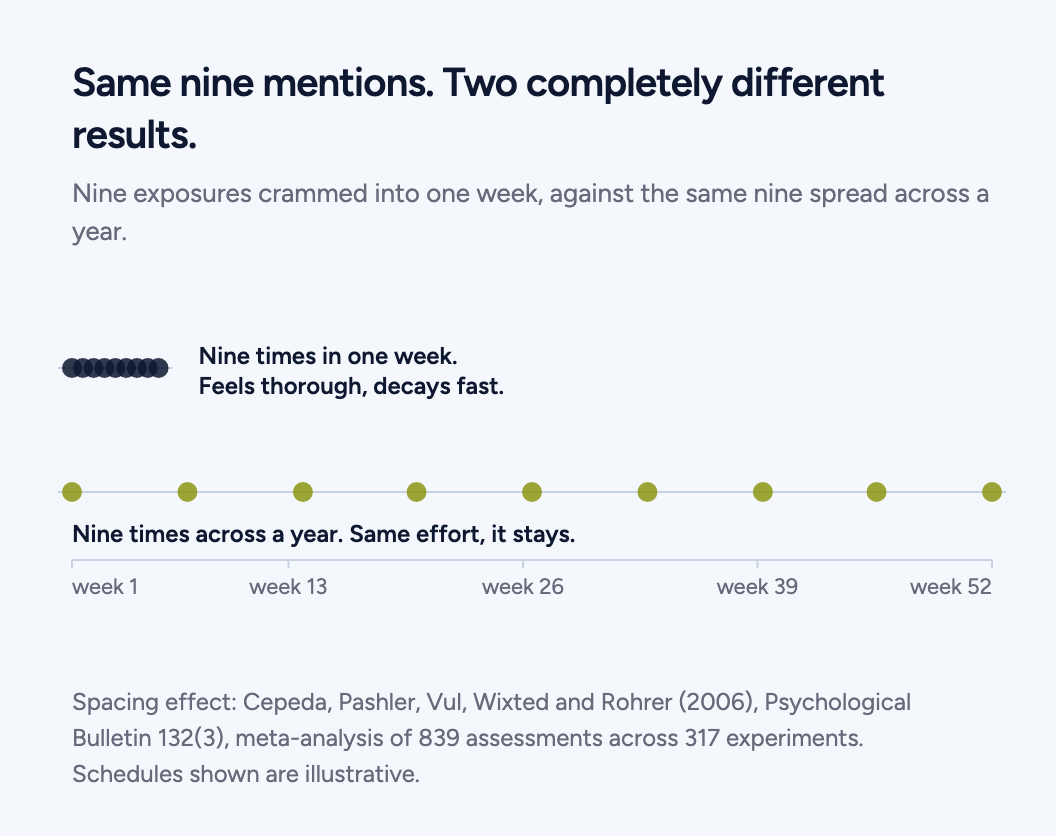
So the target is not nine mentions. It is nine mentions across months.
|
||||
|
Where this shows up in your week
The rebrand nobody needed. The CEO is bored of the line. The line is on exposure four. Six figures to reset the counter to zero. The salesperson who improvises. Twenty calls, twenty slightly different versions of what you do. That is not twenty repetitions. It is twenty first exposures, in twenty different heads. The board deck that changes every quarter. Your directors cannot repeat your strategy because they have heard four strategies. They will conclude you do not have one. The new hire at month three. Ask them what the company does. If the answer surprises you, that is not their onboarding. That is your frequency. The brief that says “we need a fresh message.” Sometimes true. Usually it means the last one was abandoned at exposure three and nobody was counting. |
||||
|
One to ask yourself
How many times have I said this, in the same words, where they could hear it? Not thought it. Not written it in a document. Said it, in the same words, to that audience. Counted honestly, most people land on three or four. |
||||
|
One to try this week
Write your one sentence. The thing you most want your market, your board or your team to repeat without you. Count where it will appear in the next ninety days. Meetings, posts, the site, the deck, the email footer, how your salespeople open a call.
Reply with your sentence and I will tell you honestly whether it is repeatable. |
||||
|
Four rules for getting to nine without becoming unbearable
Same words. Every time. Change the phrasing to keep yourself interested and you are not on repetition four. You are on four first exposures. Variation feels creative. It resets the counter. Change the container, never the content. Same sentence, new example around it. New customer, new number, new week. Keep going past the point of embarrassment. The moment it feels unbearably repetitive to you is roughly exposure four. That is where companies quit and where audiences start. 
Judge it at nine, not at one. One test: can somebody outside your company say it back to you? |
||||
|
If this was useful
Nothing to buy in this email. Send it to whoever wants to change the tagline again. If someone forwarded this to you, subscribe here. One email, Tuesday mornings.
Who we are, since you might be wondering
Brave New Media is a boutique B2B media and marketing agency. Small team, we work globally. We have only just started talking about ourselves in public, so it is fair if you are surprised to be getting email from a company with almost no footprint. We spent years doing the work and close to no time telling anyone about it. That was a choice, and on reflection it was the wrong one. It is changing quickly now, and on purpose. Until next Tuesday,
|
||||
|
Visit brave-new.com to see who we are, how we work, and what we refuse to do.
You are receiving this because you subscribed to The Brave New Business
Journal. |