|
Forwarded this? Subscribe here and get it every Tuesday. | |||||||||||||

The Brave New Business Journal
Issue 25 · Tuesday 20 October 2026 · from Anne Becheru
Who did you say you are, and what do you do?
| |||||||||||||
|
Tuesday mornings. One idea, one question, one thing to try. | |||||||||||||
|
From Anne
Last week I watched someone introduce themselves three times at the same event, and three different answers came out of their mouth. None of them were wrong. None of them landed either. If you have ever heard “so, what do you do?” and felt your own answer fall apart while you were still saying it, this one is for you. 
| |||||||||||||
|
The twenty seconds you keep losing The turn comes around the table. A partner team, a supplier review, a badge and a coffee at a conference. You get about twenty seconds and one sentence worth of attention. Most of us lose it for an odd reason. Not because we know too little about our business. Because we know too much, and we try to fit all of it into the gap. So we open with the company history, or the job title, or all three business lines, and by the time we reach the part that would have interested them, they have stopped listening. Donald Miller, who wrote Building a StoryBrand, has a line for this: “If you confuse, you lose.” The fix is not more confidence. It is a script you wrote before you needed it. | |||||||||||||
|
The canvas Miller's framework is called SB7. Seven parts, taken from the structure of almost every story people tell. He built it for brands. It works just as well for one sentence said standing up, holding a coffee. One move makes the whole thing work, and it feels wrong the first time. You are not the hero of this story. The person in front of you is. You are the guide. The moment you cast yourself as the hero, you are competing with your listener for the only role they care about. Answer these seven in writing. Not in your head. Writing is where you find out which answers you do not actually have. 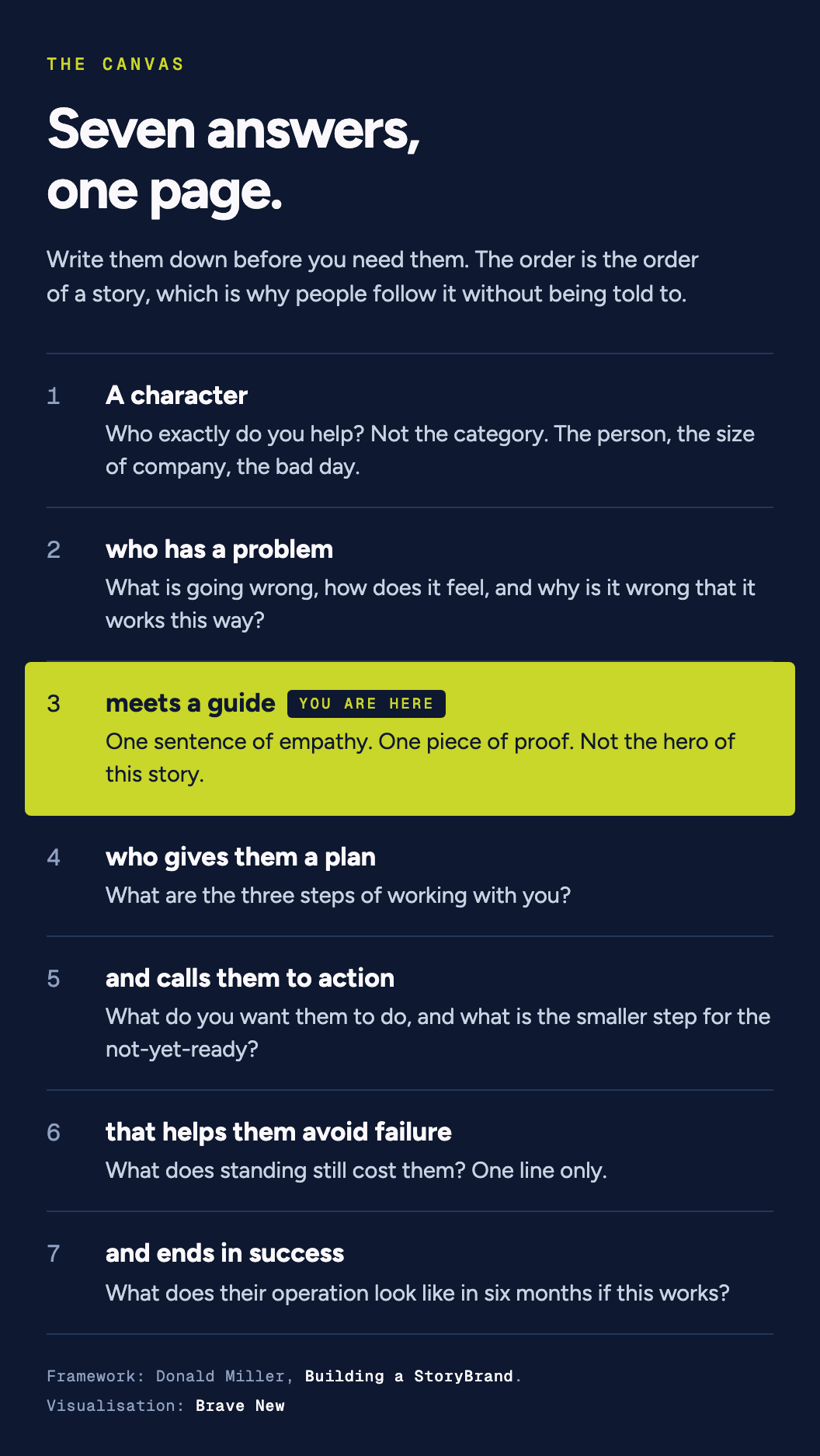
Three of those rows catch people out. The character row is where most of us write a category instead of a person. “Manufacturers” is not an answer. A plant manager at a mid-sized producer whose line stopped on Tuesday is an answer. The problem row is three questions wearing one coat. Miller splits it into external, internal and philosophical. External is the practical thing going wrong. Internal is how that makes the person feel. Philosophical is why it is wrong that things work this way at all. Most people only ever say the external one, and the external one is the least interesting. In a warehouse business it might run: stock sitting in the wrong location, the Monday call where you have no good answer, and a planner should not have to guess. The guide row is the one that feels wrong the first time. One sentence of empathy, one piece of proof. Any more proof than that and you have quietly made yourself the hero again. Written out, those seven answers fill a single page. Miller calls that page a BrandScript. It is not the thing you say. It is the thing you draw from. | |||||||||||||
|
Your sound bite The page is private. What you say out loud is one sentence pulled from it. Miller calls it the one-liner, and it has three parts in this order.
Three tests before you use it:
| |||||||||||||
|
The same page, with your name on it Everything above also works with you as the subject instead of the company. This matters more than it used to, because people now check the person before they check the firm. Who do you want in the room when your name comes up? What do they get wrong about your role? What is the one thing you want them to associate with you, and does anything you published this year actually support it? If someone searched your name tomorrow, would the first three results say the same thing your one-liner says? That last one is the test most people fail. The sentence is fine. The trail behind it says something else. | |||||||||||||
|
Writing it down
| |||||||||||||
|
An unmade decision A bad introduction is rarely a confidence problem. It is usually an unmade decision. You have not chosen who you are for, so every version of the sentence stays technically true and completely forgettable. Choosing costs something. The sentence gets narrower, and you will say a name of a customer you cannot serve and let the room know you are not for them. That is the trade. Being remembered by the right table is worth more than being vaguely acceptable to all of them. | |||||||||||||
|
Credit where it is due: the seven-part canvas and the one-liner are Donald Miller's, from Building a StoryBrand and Marketing Made Simple. We use them with clients most weeks. | |||||||||||||
|
The reading list Both of Miller's books sit on our reading list, along with everything else we hand to clients when they ask where an idea came from. Reply with “reading list” and I will send it. If you read one, read Building a StoryBrand. It is short, and the framework above is the spine of it.
| |||||||||||||
|
Before you go
Thank you for reading. This list grows every week, and the replies are the best part of mine. If this one helped, forward it to the person who introduced themselves badly next to you at the last event. | |||||||||||||
|
Brave New Hive is live We have opened a second site. It is called the Hive, and it is a marketing pedia for brands in the age of AI. Principles, the history of advertising, branding, the neuroscience underneath it, reputation, and our own research. Every entry is written from the original studies, with the sources named and the dates stated, because most of what you find online when you look up a marketing idea is now written by machines quoting each other. If this issue made you want the longer version of how messages get built, start in Principles. The Hive is where the knowledge is kept. brave-new.com is where it gets used. | |||||||||||||
|
About Brave New
Brave New is strategy-led growth for high-stakes B2B. We work in four stages. Position, which is the one decision the machine cannot make for you. Build, which turns that position into authority the market remembers and believes. Go broad, which puts it in the market at scale. Prove, which measures what a board recognises rather than impressions. The point is not visibility for its own sake. It is becoming the name your market searches for. | |||||||||||||
|
Visit brave-new.com to see who we are, how we work, and what we refuse to do.
You are receiving this because you subscribed to The Brave New Business Journal. |