|
Forwarded this? Subscribe here and get it every Tuesday. | ||||||||

The Brave New Business Journal
Tuesday 3 November 2026 · from Anne Becheru
Playing it safe is how you become average
| ||||||||
|
Tuesday mornings. One idea, one question, one thing to try. | ||||||||
|
From Anne
Hello, Most people don't stay average because they lack talent. They stay there because the safe choice always sounds sensible at the time. Wait a quarter. Run one more check. Don't rock the boat. This week is about what that sensible voice costs. 
This issue is about 1,000 words, a 4-minute read. The short version:
| ||||||||
|
Average is now the cheapest thing you can be Codie Sanchez builds and buys small businesses, and she put it bluntly in a video this weekend: “Average and mediocre is now the cheapest thing you can be because a machine makes it for free. Original is expensive again because it's scarce again.” There is research behind this. In 2024, Anil Doshi (UCL School of Management) and Oliver Hauser (University of Exeter) ran an experiment in which some writers got story ideas from an AI tool and others did not. Stories written with AI ideas were rated more creative. Writers who saw five AI ideas produced stories rated 8.1% more novel than writers with no AI help. But the AI-assisted stories were also more similar to each other. Each writer got a little better, and together they started to sound the same. That is what is happening to websites, LinkedIn posts, pitch decks and sales emails right now. Everyone uses the same tools, so everyone lands in the same middle. When everyone can produce “good enough” for free, the only thing worth paying for is the thing nobody else would have made. Source: Doshi and Hauser, “Generative AI enhances individual creativity but reduces the collective diversity of novel content”, Science Advances, July 2024. | ||||||||
|
Fear is why most people stay in the middle The Global Entrepreneurship Monitor surveys more than 150,000 adults in around 50 countries. In 2019, 44% said they would not start a business because they were afraid it might fail. In 2024, that rose to 49%. The more telling number: among people who said they could see a good business opportunity, 47% said fear would still stop them from going for it, up from 42% in 2019. The opportunity is there. The fear wins anyway. 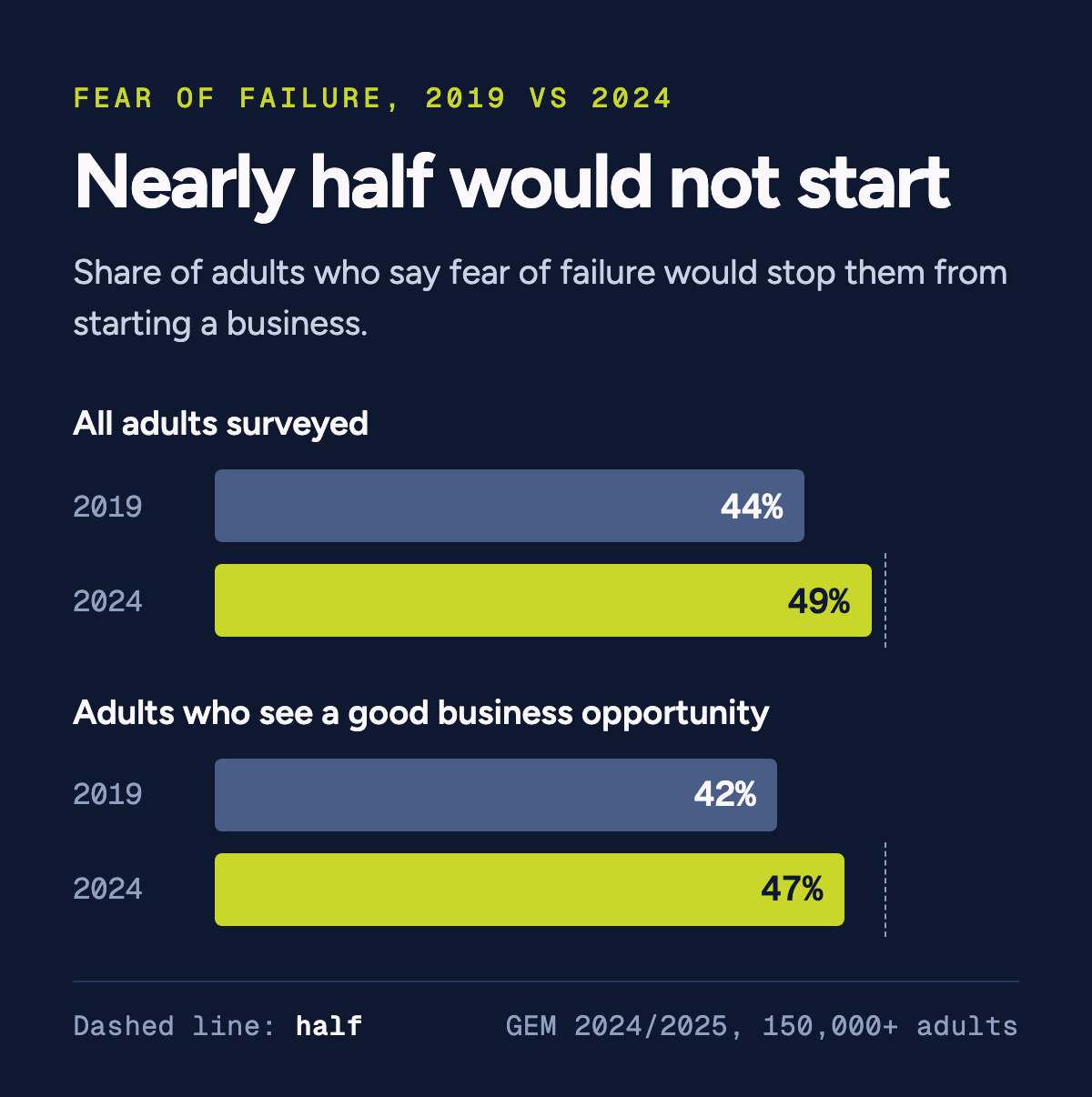
Part of the reason is how our brains score risk. In their 1992 work on prospect theory, Amos Tversky and Daniel Kahneman estimated that a loss feels about 2.25 times as heavy as a gain of the same size. Later studies put the number lower, closer to 1.5 to 2, but the direction holds: losing 1,000 euros hurts more than winning 1,000 euros feels good. So we overpay to avoid the loss, and the price is usually the upside. 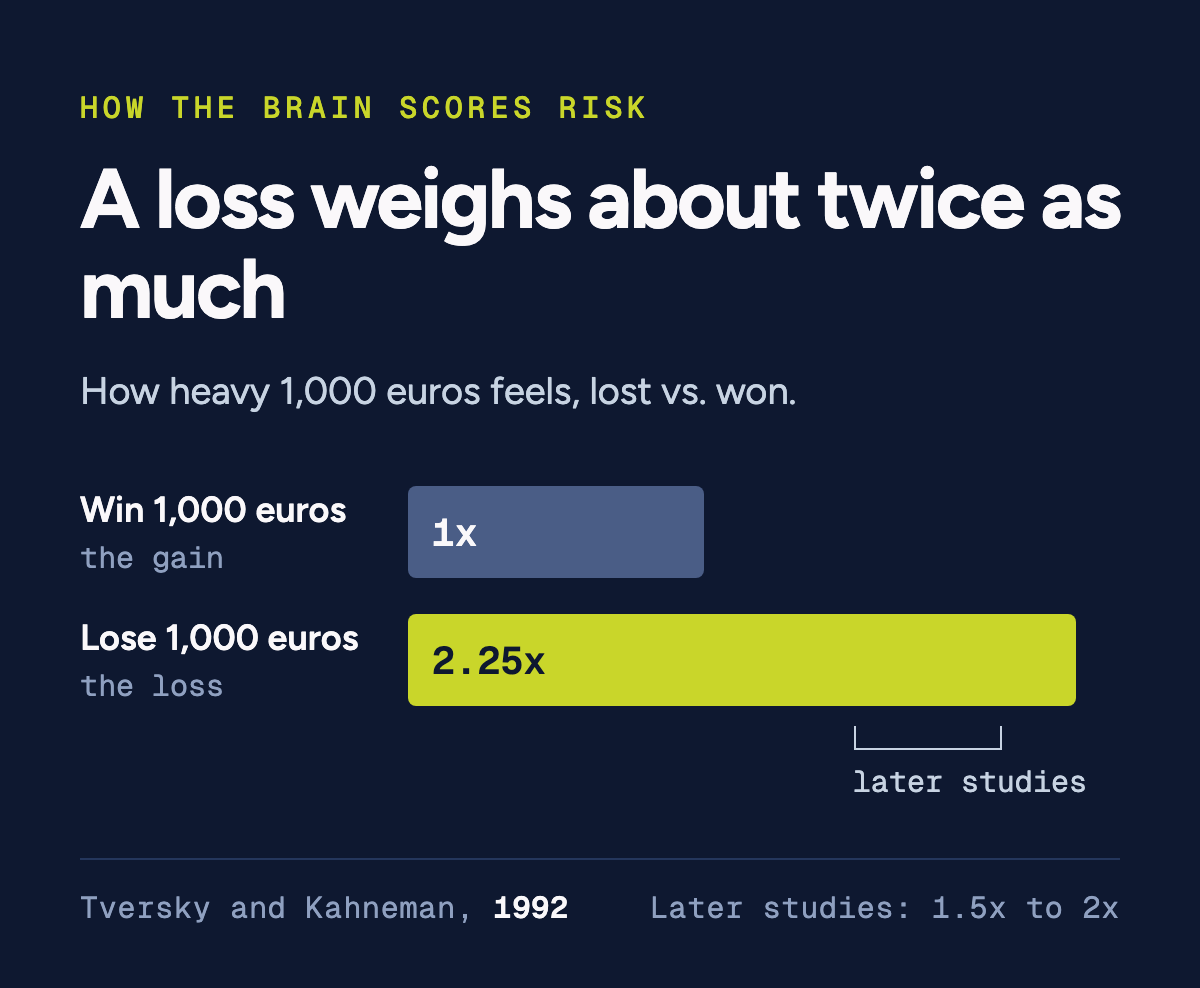
Fear rarely says no. It says “not yet”, and “not yet” is how most good ideas die. Source: GEM 2024/2025 Global Report, “Entrepreneurship Reality Check”, February 2025. Tversky and Kahneman, “Advances in Prospect Theory”, 1992. | ||||||||
|
How winners turn average The most useful part of Codie Sanchez's video is what she calls the creativity death spiral. You start with nothing to lose, so you take risks. Some of them work, and you grow. Now you have something to lose: money, reputation, time. So you protect it. You take fewer risks. Fewer risks means less growth, so you protect even harder. That is how interesting companies turn into boring ones. 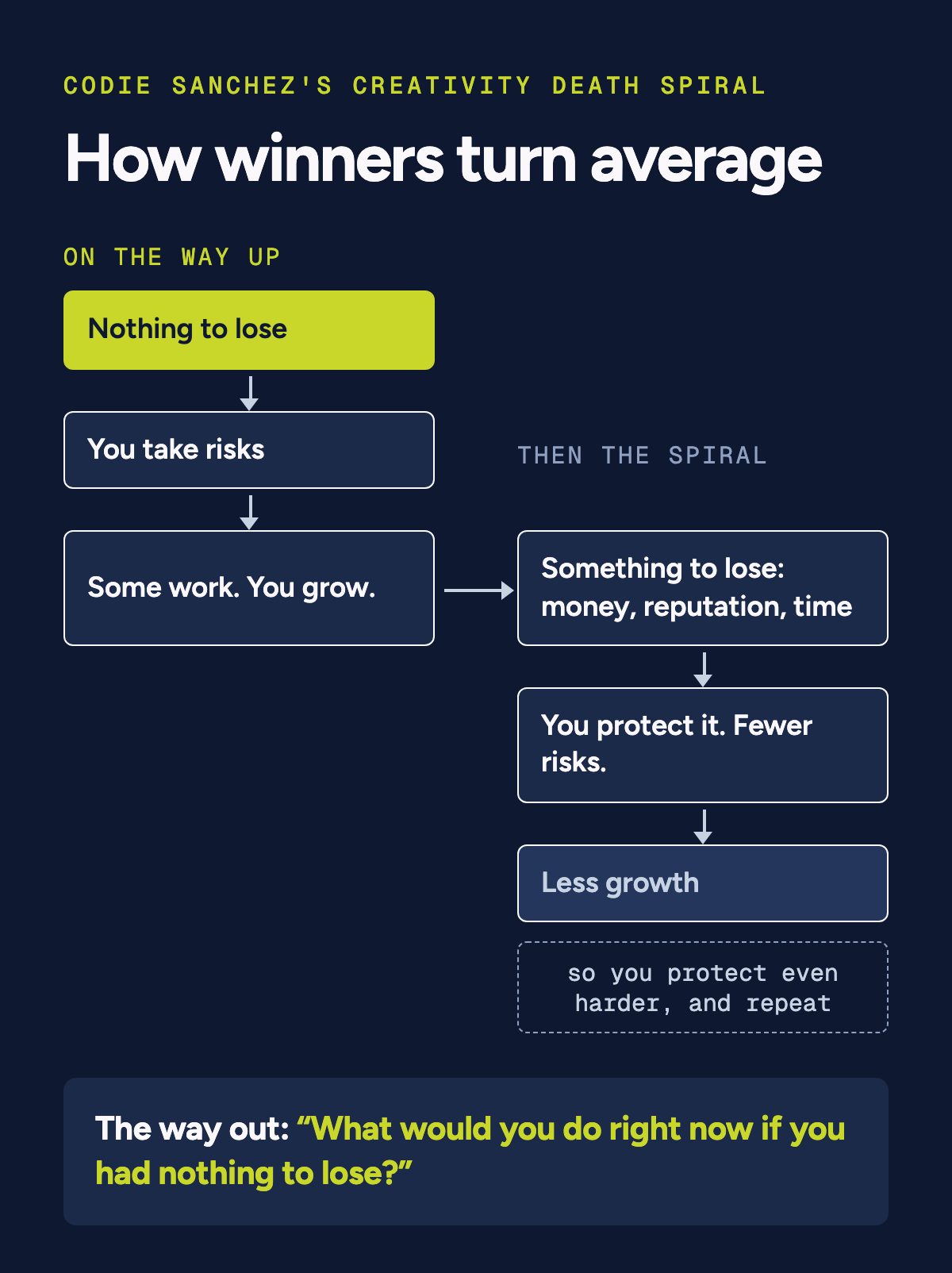
Her example is BlackBerry. It was the first company to put email in your pocket. When Apple launched a touchscreen phone, BlackBerry's leadership decided they would be fine. The question she asks is a useful one: “What would you do right now if you had nothing to lose?” That version of you is usually the one who built the business in the first place. Success is the most dangerous moment to start playing safe, because it is the moment you can most afford a risk. | ||||||||
|
What you will actually regret In the 1990s, the psychologists Thomas Gilovich and Victoria Medvec studied what people regret. In the short term, people regret their actions more: the bad hire, the failed launch, the awkward email. Over a whole life, it flips. In one of their studies, 84% of people said their biggest lifetime regret was something they had failed to do. A much larger replication in 2023, with about 2,600 people, found the same pattern, though weaker. Over a few days, our mistakes hurt most. Over a lifetime, the things we never tried catch up. The risk you take will sting for a week. The one you skip can stay with you for years. Source: Gilovich and Medvec, “The experience of regret”, Psychological Review, 1995. Richardson and colleagues, “A very public replication of the temporal pattern to people's regrets”, Royal Society Open Science, June 2023. | ||||||||
|
One rule for taking smarter risks Codie Sanchez's rule is 70, 20, 10. Put 70% of your time and money into what is proven. Put 20% into improving what is proven. Put 10% into a wild card: an idea that might lose money, and might also change everything. The point is that nobody has to be fearless. You only have to be brave with a tenth of what you have. She adds a second distinction worth keeping: rules versus laws. A law is something that ends your business if you break it, like spending more than you earn forever. A rule is just something everyone agreed on and keeps repeating, like “we don't post on social media” or “that's not how it's done in our industry.” You cannot break laws. You can break rules, and most of the people who got ahead did. 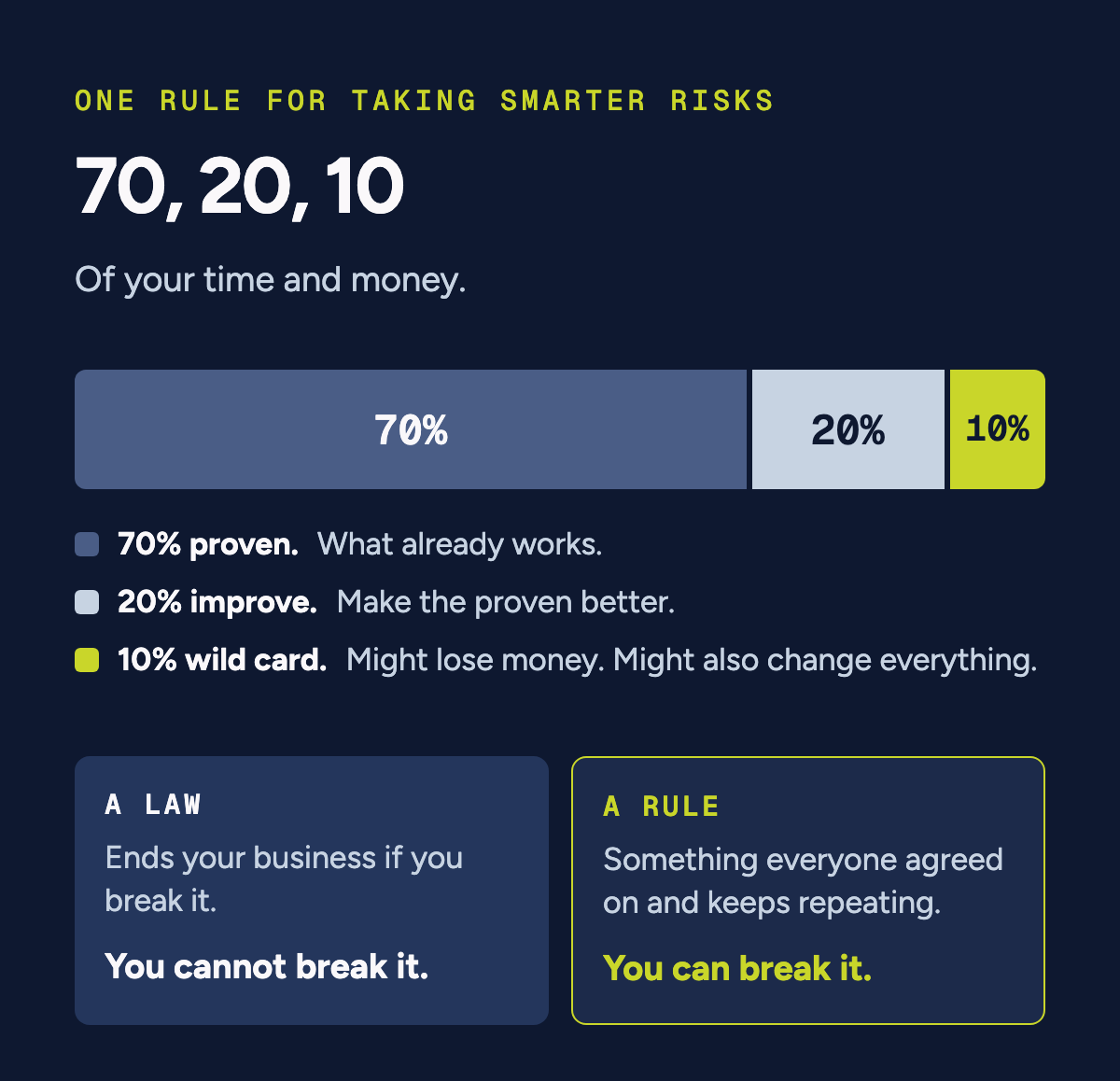
| ||||||||
|
Your 10 percent
| ||||||||
|
Before you close this Fear is useful. It keeps us from doing stupid things. But in business it rarely stops us from doing stupid things. Mostly it stops us from doing new ones. Codie Sanchez ends her video with this: “Average is the choice you make every day you don't decide otherwise.” So ask yourself: where am I a little scared right now? And what would I do there if I had nothing to lose? Then do the smallest version of it. Tell me how it went. Just reply to this email. | ||||||||
|
From the blog: is bravery worth more than brains?
| ||||||||
P.S. Reply TEN and tell me your 10% bet: the idea you have been calling too risky. I'll read every one. | ||||||||
|
Missed last week? We wrote about testing an idea small before you bet on it. Read it here Know someone who has been playing it safe for too long? Forward this to them. Was this forwarded to you? Get the Journal every Tuesday at brave-new.com. | ||||||||
|
About Brave New
Strategy-led growth for high-stakes B2B. Position, build, go broad, prove. The point is to become the name your market searches for. | ||||||||
|
Visit brave-new.com to see who we are, how we work, and what we refuse to do.
You are receiving this because you subscribed to The Brave New Business Journal. |