Every speaker left the room with one checkable claim: ARK's growth figure, Palmer Luckey's price comparison, Astro Teller's definition of a moonshot. The sentence that matters for a B2B brand came from Emad Mostaque: within a year, agents rather than developers will be choosing tools. The shortlist they draw from is whatever you have published in a form a machine can find and attribute: your definitions, your numbers, your named customers.
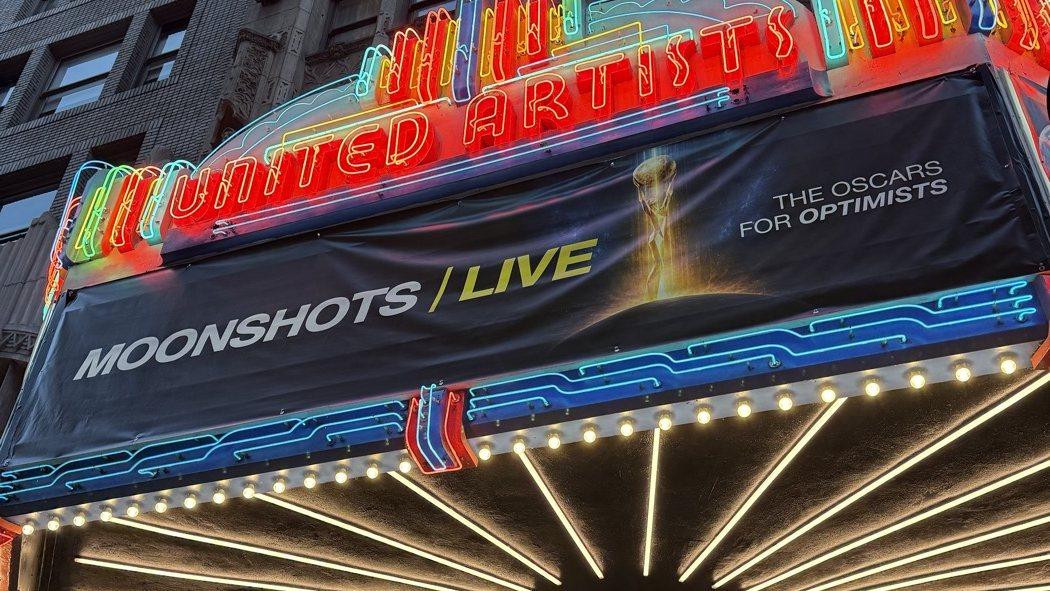
Moonshots Live filled a restored 1920s movie palace in downtown Los Angeles on 25 September 2026. Peter Diamandis called it the Oscars for Optimists. Fifteen hundred builders sat through ten hours of stages, prizes and forecasts. Nobody on stage was selling a product. They were selling a decade, and the buyers were founders.
The room
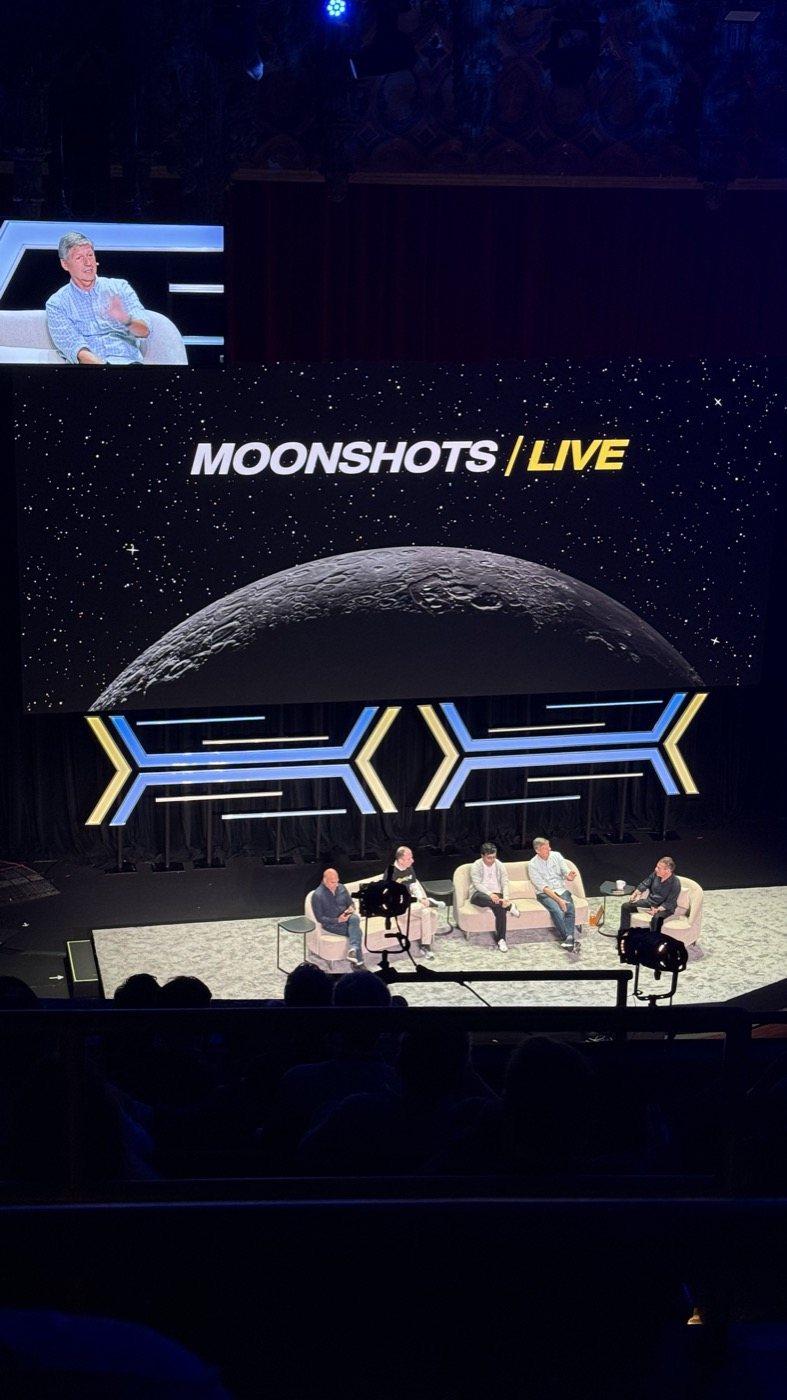
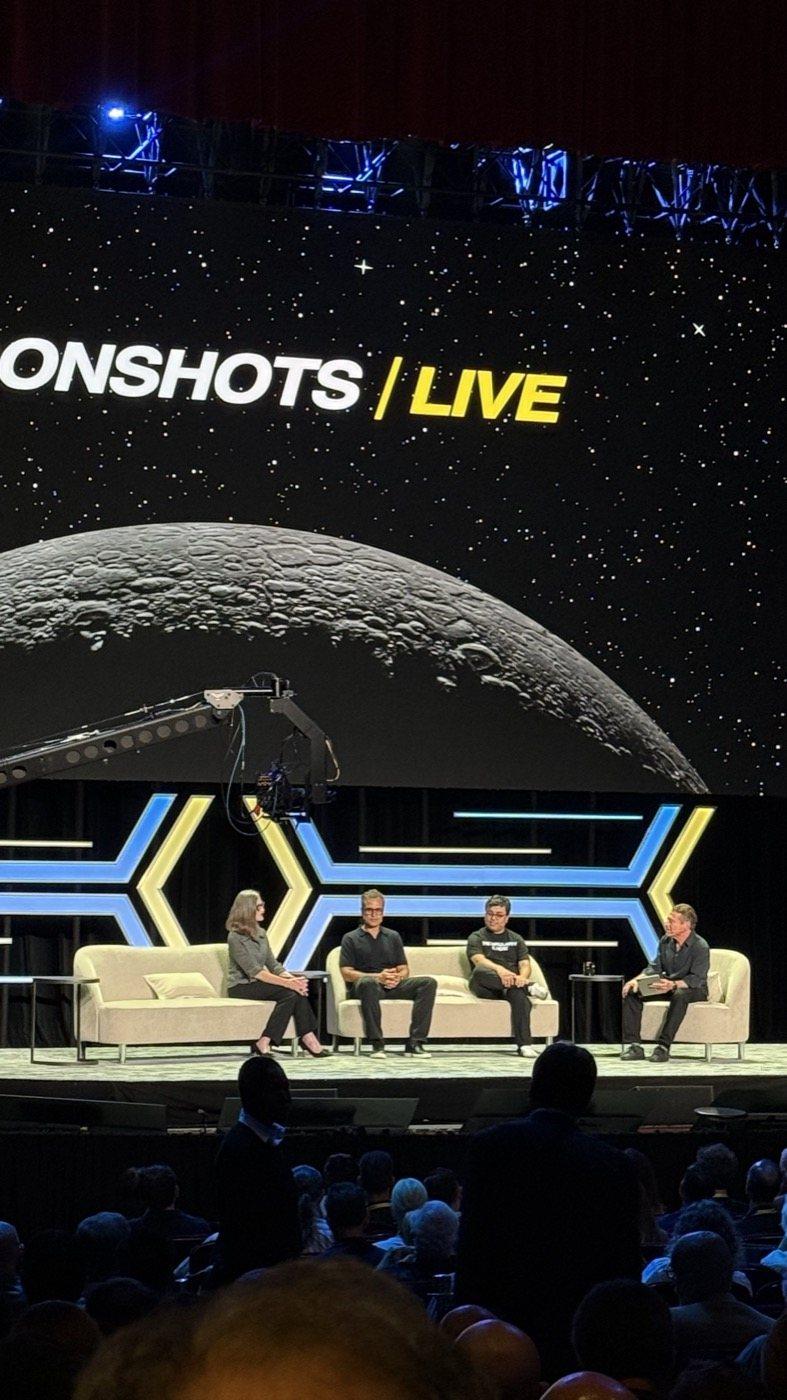
The inaugural Moonshots Live ran for one day at the United Theater and Belasco, hosted by Diamandis with the Moonshots Mates: Alex Wissner-Gross, Salim Ismail, Dave Blundin and Emad Mostaque. The night before had been a Star Trek 60th anniversary premiere, and Diamandis opened by asking the room to “give it up for William Shatner”.
He set the frame in the first minute. “Our mission is to keep you hopeful, optimistic, and to inspire you to find your massive transformative purpose, to choose your moonshot, and to make it happen.” Later he added the line the room repeated for the rest of the day: “A year from today, we’ll all be like, ‘Wow, remember how slow it was?’”
Every speaker sold a position
Not one talk was a product demonstration. Each one handed the audience a sentence to carry out of the building.
Palmer Luckey, founder of Anduril and Oculus, used arithmetic rather than adjectives: “You can buy 2 weeks of calories for less than one hour of federal minimum wage labor.” On his own trade he was drier still. “Being a founder was always like AI took your job. It’s just that other people took it.” His forecast was narrow on purpose: defence robotics will stay “this weird branch of exotic, highly specialized robotic systems” while manufacturing, hospitality and medicine may converge on shared forms.
Alex Wissner-Gross argued that intelligence will need infrastructure the way cities do. Cities have “police forces and fire departments and all sorts of other municipal services that defensively co-scale with the population. The singularity I claim is going to need exactly the same thing.” He also described training “digital twins of cells” until “every biology problem… is just going to become a search problem”. Salim Ismail compressed the same claim into three words: “Biology is cooked.”
Ben Lamm of Colossal Biosciences took the opposite tack and made trust the argument. “I believe in technology, but I believe in humanity first. And people will help you.” When Cathie Wood sent a question from backstage about Anthropic announcing wet labs, Lamm called it “massively validating” and “a huge watershed moment for the industry”. Astro Teller, captain of moonshots at X, supplied the day’s definition: “a moonshot is a structured what if”, and “moonshots are speeding up, not slowing down.”
Cathie Wood’s numbers
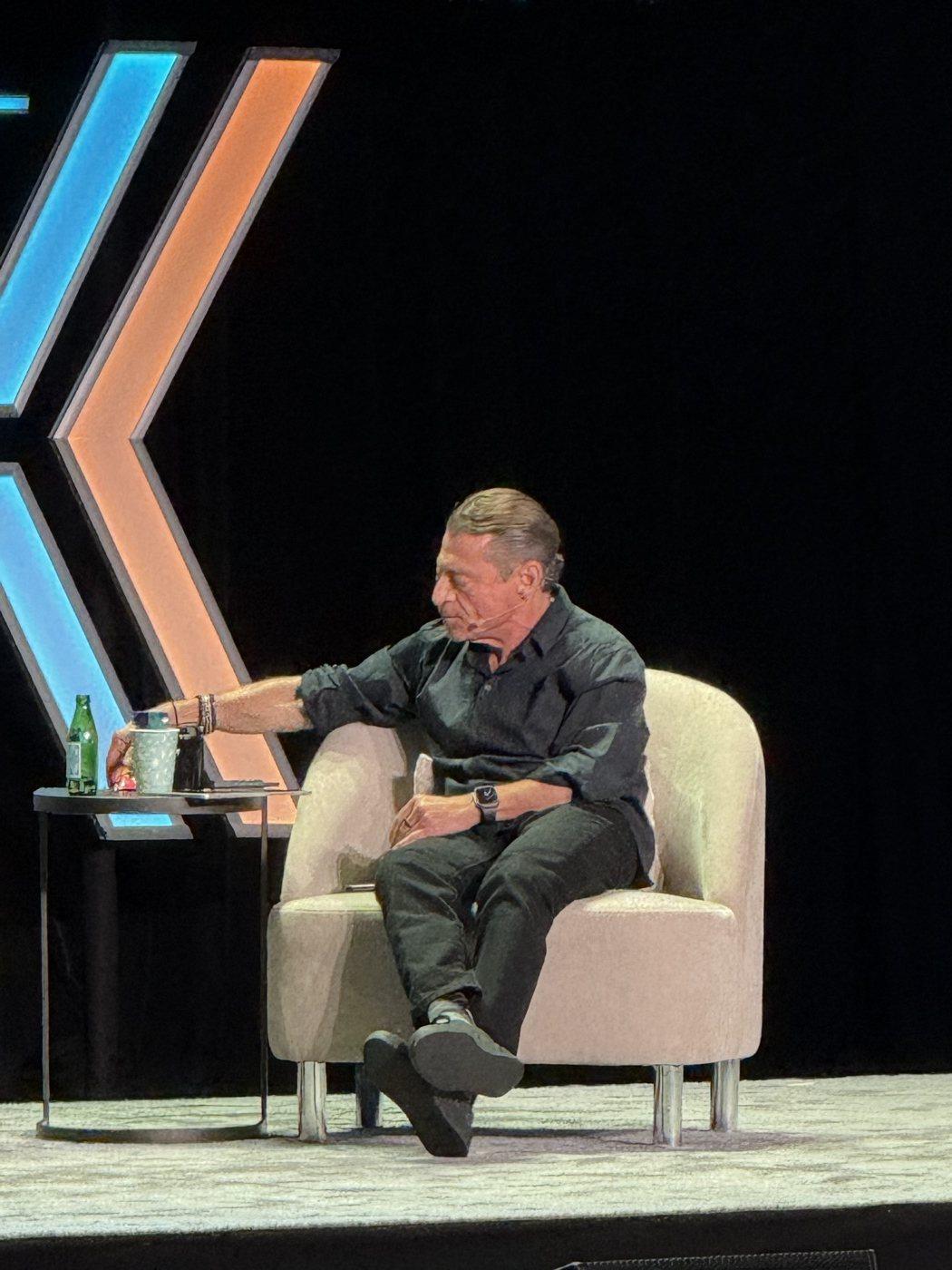
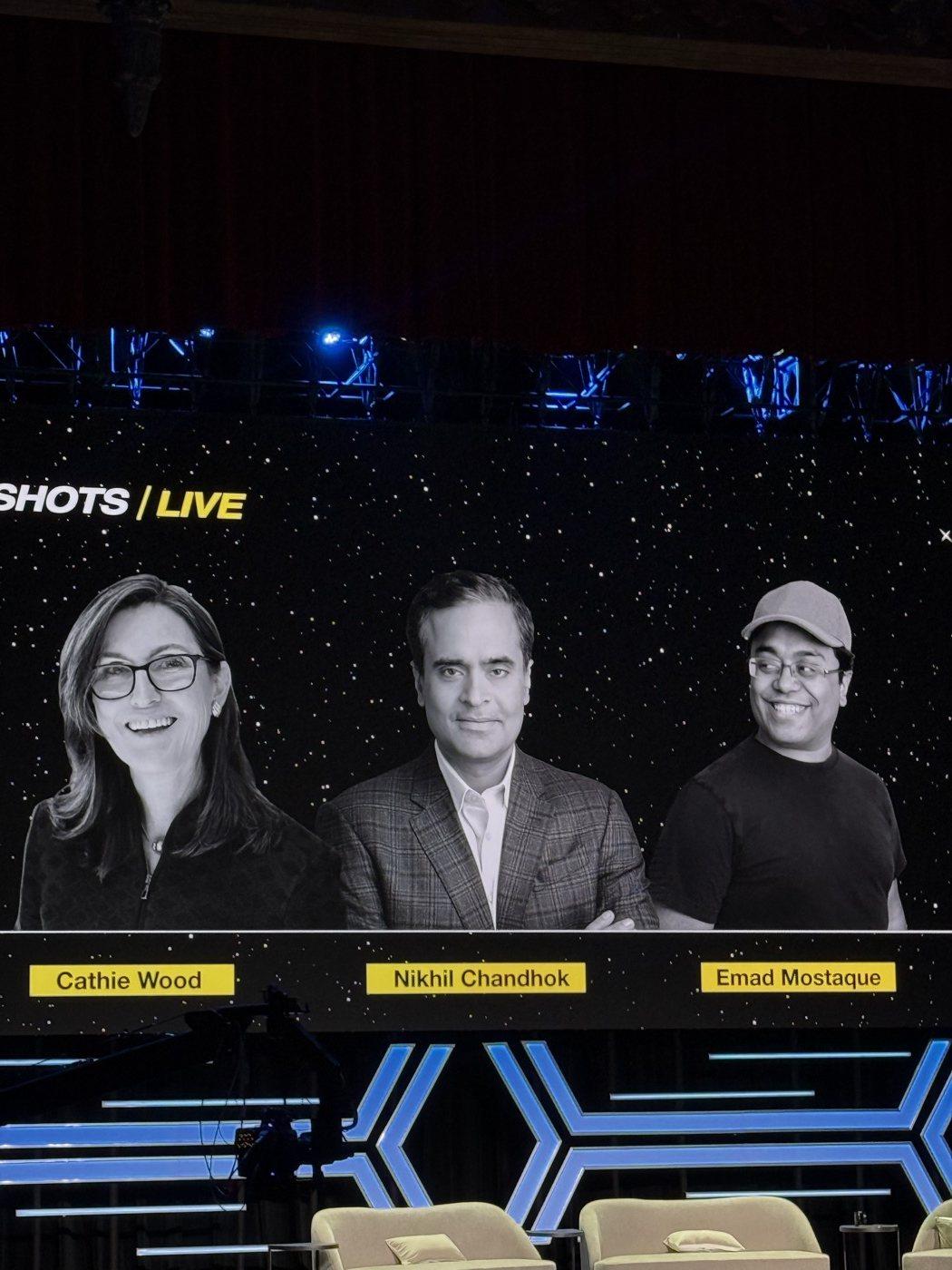
Wood flew in from Portugal the night before and was introduced with her own sentence: “Bitcoin we believe is going to be the most important crypto asset especially as we move to agentic AI where machines will be buying from other machines.”
On the afternoon panel, “Big Ideas and the agentic economy”, she gave ARK’s headline forecast as “7 to 8% real GDP growth” accelerating over the next five years, after Diamandis cited the Fed reporting “something like 4.7% GDP growth in the last quarter”. She was more careful on humanoids than the room expected. ARK concluded a humanoid robot is “200,000 times more complex” than a robotaxi, with hands as the hardest part, which put her scaling estimate “a couple of years later” than Elon Musk’s late 2028 to 2029.
On robotaxis she said Waymo has disclosed that it has surpassed human drivers on safety. Diamandis supplied the public cost: if all cars were as safe as Waymos, “there’d be 40,000 less deaths per year and about 400 billion less in medical fees”. On the constraint nobody on stage could route around, it was Diamandis who put the numbers to her: “80% of Americans fear AI”, and “73% say no data center in my backyard, which is more than people say no nuclear reactor in my backyard”. Her answer was that a data center nearby is “actually over time going to lower your electricity costs”, and that nuclear power “stopped in its tracks in the 70s because of regulation”. She said she founded ARK “for this time”, because institutional equity investing had shifted to passive after the dot-com and 2008 busts.
The prizes were a go-to-market with proof attached
Two XPRIZEs were handed out, and both were built so the winner became evidence.
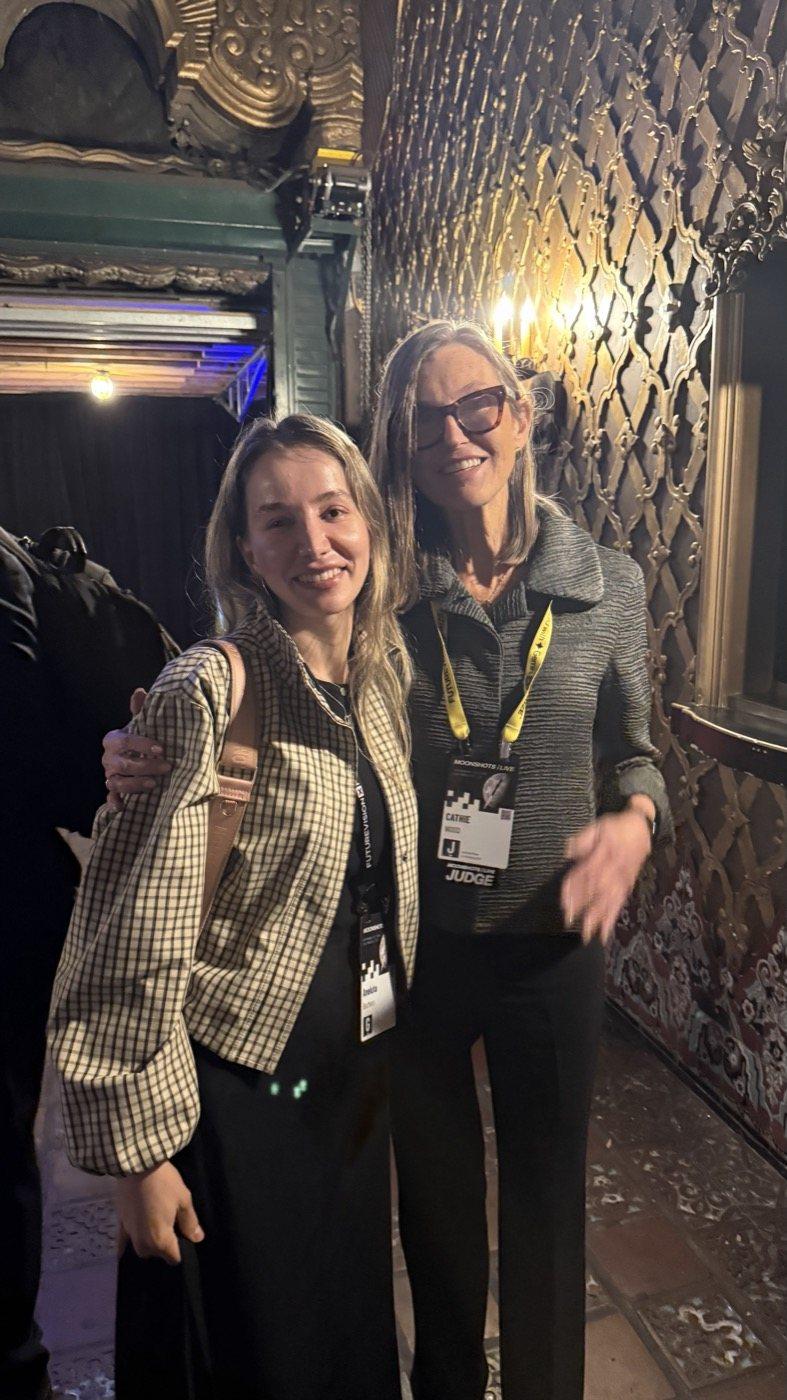
The Build with Gemini XPRIZE put up $2 million. XPRIZE reported more than 26,000 builders registered, with 90 days from a clean sheet to a revenue-generating company solving a problem for at least 100,000 people. The judges were Palmer Luckey, Cathie Wood, Logan Kilpatrick of Google and Mark Pincus. Polyfork won $500,000, built by Lucas, from Chile and based in Berlin, a store for AI-native remixable 3D assets. Diamandis called the cheque “non-dilutive seed capital, the best kind”. Tissen Sierra took $200,000, built by Edgar in Mexico to recover VAT credits for Mexican businesses with an AI auditor. Third was My Fixum from Nigeria, a marketplace for informal artisans, whose pitch reported that “93% of workers have no safe way to get paid”. LaunchBridge, from UVA students, placed fourth and Dodo Prep from India fifth with $100,000. Fifteen runners-up received $50,000 each. Google funded most of the prize pool. Keith Ferrazzi coached the teams.
The Future Vision XPRIZE ran on the same logic in film: over $3.5 million, more than 5,000 entries of which over 2,500 delivered a trailer and treatment, narrowed by Diamandis’s account to 100, then 50, 25, 10 and 5. The judges were Neil deGrasse Tyson, Neal Stephenson, Mira Lane of Google and Rod Roddenberry, who also hosted. The brief was a single rule: “show us a future worth building. Not a utopia or another Terminator saga.” The grand prize went to “The Gifted” by Jeff Synthesized, real name Jeff D. Thomas, which will be produced with Range Media Partners under CEO Peter Micelli, with Diamandis saying the film will likely carry “a $10 to $15 million budget”. All five finalists received $100,000, and The Gifted also took the $50,000 audience choice after over 800,000 votes. Five runners-up received $20,000 each from Jack Hidary of SandboxAQ.
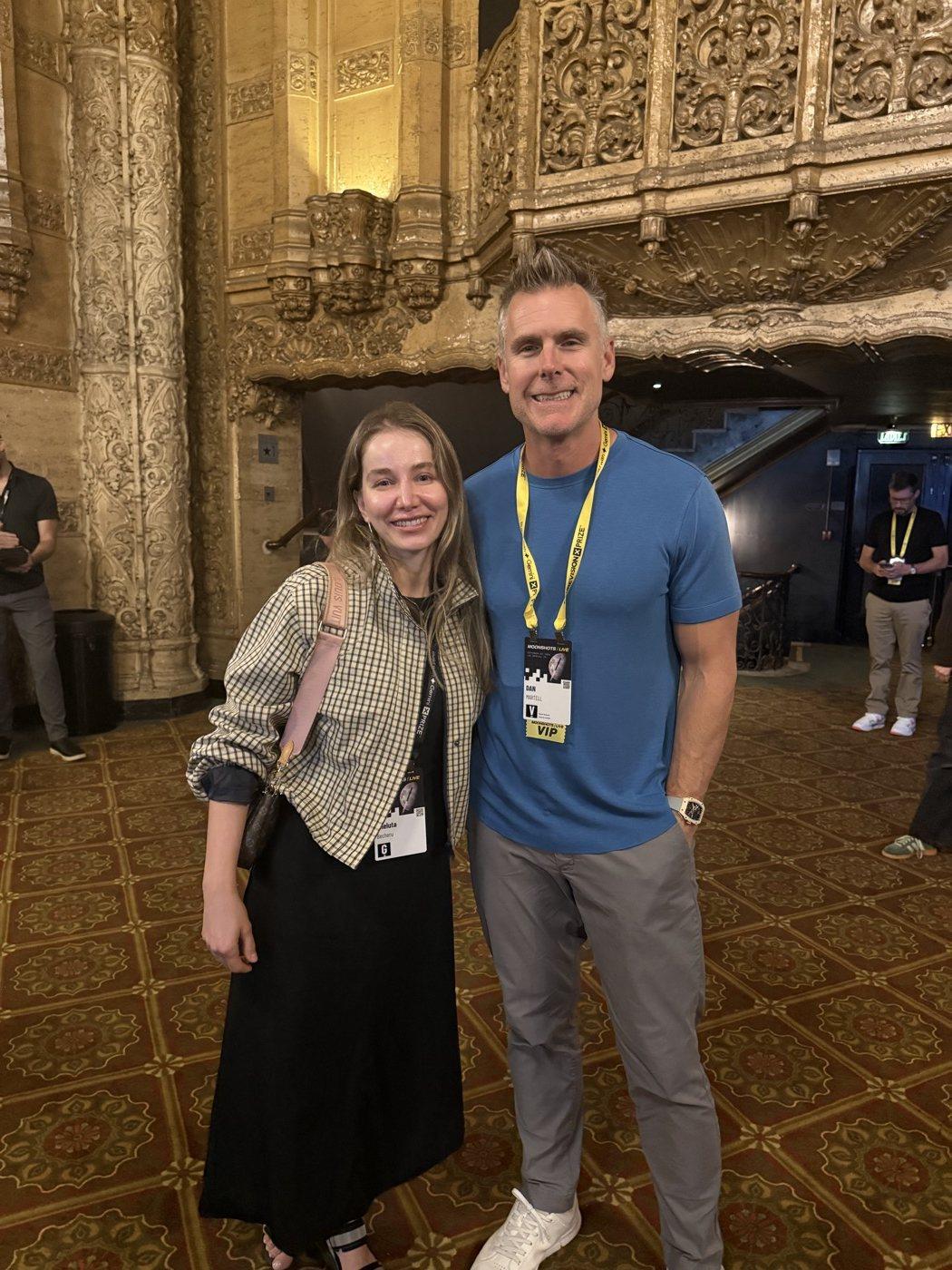
Dan Martell was thanked from the stage as the other major donor alongside Google, introduced as someone who “runs an incredible accelerator” and is “an entrepreneur many many times over”, and he handed over the envelopes.
A cheque is an opinion. A company that exists 90 days after a clean sheet, or a film with a production company and a budget attached, is proof. That is the structural difference between sponsoring an idea and demonstrating one, and it is why these prizes did more for the agenda than any keynote in the building.
The line that should change what you publish
Emad Mostaque gave the most operationally useful sentence of the day. Within “9 months, 12 months”, he argued, agents rather than developers will be choosing tools, so companies should be putting their data on the internet now for the agents to find. Diamandis pushed further and asked what happens when more AIs than humans are transacting online.
The panel’s other numbers described the plumbing for that world. Nikhil Chandhok of Circle, the event’s sponsor, said USDC has “settled over a hundred trillion” across 30 public blockchains, that roughly $3 trillion sits in motion in international banking at any moment because settlement protocols are old, and that a transaction costs about 0.005 cents to settle on Circle’s ARC chain against 89 cents on Ethereum, from “data we got yesterday”. Wood returned to biology by way of the same idea: “each one of us is a data factory”, with “35 to 40 trillion cells”, and she noted that health care and technology analysts do not play well together.
Steven Wolfe Pereira’s recap named the through-line: “one idea connected almost everything: We are on the exponential intelligence curve.” Diamandis had written something closer to the discomfort in his June 2026 newsletter. “The containers we built for the old world are cracking under the new one.”
What this means for a B2B brand
Mostaque’s forecast is a marketing instruction wearing engineering clothes. If a machine shortlists your category inside a year, the shortlist is drawn from what has been published in a form a machine can retrieve and attribute: your definitions, your numbers, your named customers, your dated method.
Nothing in that room was won by volume. Wood carried one growth figure. Luckey carried one price comparison. Teller carried one definition. Each was short enough to be quoted by a person and specific enough to be checked by a machine, which is the same requirement arriving from two directions.
The division of labour follows from that. People decide the position, because choosing which number you will be known for is a judgement. A system keeps it current, because retrievability decays quietly and there is no announcement when your competitor’s figure becomes the one that gets returned first.
Fifteen hundred people spent a day buying a version of the next ten years. The firms that get named inside it will be the ones that put their definitions, their numbers and their names where the agents read.
FAQ
Is an event like this worth a B2B leadership team’s time, or is it founder entertainment?
It is worth attending as market research on how positions get sold. Every talk on 25 September 2026 was one checkable claim delivered without a product slide: ARK’s “7 to 8% real GDP growth”, Palmer Luckey’s two weeks of calories against an hour of minimum wage, Astro Teller’s “a moonshot is a structured what if”. That discipline transfers to a procurement deck.
Agents will be choosing tools within a year. What do we actually do this quarter?
Put your own category definitions, pricing logic, methodology and named outcomes on your own site, in plain text, dated, attributable. Mostaque’s advice on the Moonshots Live panel was to get data onto the internet now for the agents to find. Start with the five questions a buyer’s assistant would ask about your category and answer them where they can be cited.
Can we cite someone else’s forecast, like ARK’s growth number, without looking like we are borrowing authority?
Yes, if you name the source, the date and what you do differently because of it. Quoting Cathie Wood’s figure adds nothing on its own. Quoting it and then stating the decision it changed in your own operation makes it evidence of judgement. Borrowed authority reads badly when the citation replaces a position rather than supporting one.
Sources
- moonshots.com, Moonshots Live event pages
- Moonshots Live stream, StarTalk Plus channel, YouTube, 25 September 2026 (ten hours)
- XPRIZE press release, 12 August 2026
- XPRIZE, "Future Vision XPRIZE and Build with Gemini XPRIZE Name Top Five Finalists", 21 September 2026
- Peter Diamandis, LinkedIn and X posts, September 2026
- Peter Diamandis newsletter, June 2026
- Steven Wolfe Pereira, LinkedIn recap, September 2026

Anne leads content, strategy and SEO across the Brave New client roster.