
Risk is that you do not know which outcome you are going to get, and your plan only describes one of them. Howard Marks's four rules explain why the single number in your marketing deck is the least useful thing in it, why the channel that has always worked is where your real exposure now sits, and why "we decided to wait another quarter" belongs on the risk register next to everything else.
Article 1 of 3 on risk. Also in this series: You cannot see risk, only the price · Is bravery worth more than brains?
I want to start with the sentence that ruined a lot of my old thinking about marketing plans.
“Risk means more things can happen than will happen.”
That is Elroy Dimson of the London Business School, and the investor Howard Marks has been repeating it for most of his career. It took me an embarrassingly long time to notice what it actually says.
Risk is not a property of the future. It is a property of what you know about the future.
If only one thing could happen when you launched, there would be no risk at all, however bad that one thing was. You would simply plan for it. The risk lives in the gap between how many things could happen and the one thing that does.
Which means most of the risk conversations I have sat in, on both sides of the table, were about the wrong subject entirely. We were arguing about whether the number was right. Nobody asked how many numbers were possible.
Why is the future a range and not a number?
Marks builds a second rule straight off Dimson. The future should not be seen as a fixed outcome that is going to happen and can be predicted. It should be seen as a range of possibilities, and if you have any insight into how likely each one is, as a probability distribution.
Marketing planning does the exact opposite of this, every year, in every company I have worked with.
It produces a number. One pipeline target, one cost per acquisition, one launch date, on one slide. Everybody in the room knows the number is wrong. Nobody says so, because a range is harder to present and much harder to be congratulated for. “We expect between 40 and 220 qualified leads” is an honest sentence that has never once been applauded in a board meeting.
Peter Bernstein, quoted by Marks, said the honest version: there is a range of outcomes, and we do not know where the actual outcome will land inside it. Often we do not even know what the range is.
That second sentence is the one worth writing on something. Not knowing where you will land inside a known range is ordinary uncertainty, and a mature market gives you that. Not knowing the range at all is a different animal, and it is where every new product, new market and new category actually lives.
And before anyone objects that the professionals manage it, look at the professionals’ record.
Hites Ahir and Prakash Loungani at the IMF went through Consensus Economics forecasts across 77 countries. In 2008, thirteen recessions arrived. By April of that year, economists had forecast none of them. By September, two. Then in 2009 the same forecasters over-called it, predicting 54 recessions against 49 that happened. Loungani’s earlier summary of the literature is the line that stuck with me: the record of failure to predict recessions is virtually unblemished.
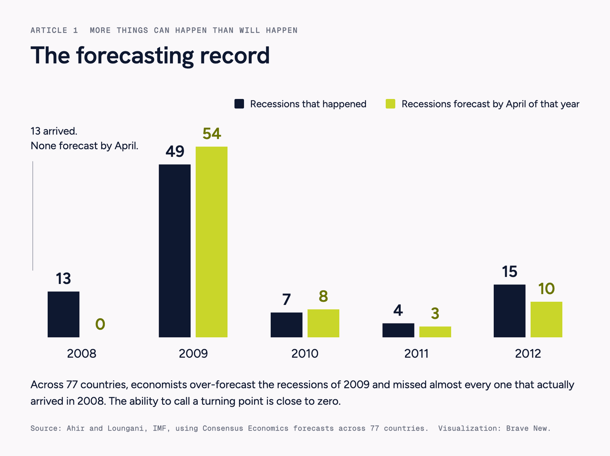
That is not a criticism of economists. It is the strongest available evidence that the future is a range and not a point, produced by the people with the most resources, the best data and the most incentive to prove otherwise. Your Q3 pipeline forecast was not built with any of those advantages.
If I know the conversion rate, do I know what will happen?
No, and this is the rule people find hardest because it sounds like pedantry right up until it costs a budget.
Marks’s example is a commentator on Super Bowl morning in 2016, talking about a heavily favoured team. “Carolina wins eight times out of ten. This could be one of the two.”
Eleven words, and it is a complete education in how to read your own dashboard.
Your landing page converts at 3%. Your outbound sequence books a meeting one time in forty. Your category has a 9 month sales cycle. Every one of those is a description of the universe of outcomes. None of them tells you what happens to this campaign, this quarter, this launch.
Chris Geczy at Wharton gave Marks the phrase for it: we live in the sample, not the universe.
The distribution is real. You get exactly one draw from it. One launch. One rebrand. One hire for the head of growth role. One shot at the category before somebody else names it. Everything you have ever read about benchmarks describes the universe, and you are only ever going to experience the sample.
This is why “the industry average CAC is X” is a genuinely dangerous sentence. It is true, and it will not happen to you.
Why the average outcome is often impossible
Then Marks flips Dimson round, and this is the sharpest thing in the whole framework for anybody who has ever built a business case.
Many things can happen. Only one will.
So the expected value, the probability-weighted average sitting underneath most business cases ever written, can be completely irrelevant. Often, Marks points out, the expected value is not even among the possible outcomes.
Take a tender, a pitch, or a category bet. Win it and the year works. Lose it and you are back where you started. At even odds the expected value is half the prize, and half the prize is the one result that cannot happen. You are getting all of it or none of it.
Plan around the average and you have planned around the only impossible number in the set.
There is a worse version, and it is the one that kills companies rather than quarters. A high expected value can pull you into something with a downside you cannot survive. The average looks great in the model. The bad tail ends the business. Averages do not make payroll in the month the bad tail arrives.
Any founder who has funded a launch out of operating cash rather than a ring-fenced budget has run this exact experiment on themselves.
Why do smart marketers keep misreading risk?
Because risk runs in the opposite direction to how it feels.
Marks: there are few things as risky as the widespread belief that there is no risk.
When everyone agrees something is safe, they get careless around it, and the carelessness is the risk. When everyone agrees something is dangerous, they get careful, and the care makes it safer.
His illustration is the SUV. Drivers of big vehicles feel protected in a crash, so they drive harder, and the fatality data does not reward them for the extra steel. Feeling safe increases risk. Being aware of risk reduces it.
You can supply the commercial version yourself. The channel that has always delivered, so nobody has tested an alternative in three years. The client who has never complained, so nobody has asked them how it is going. The message that has worked since 2021, so nobody has checked whether the market still hears it that way. The distinctive asset everyone internally is bored of, right at the moment it is doing the most work.
Every one of those carries more risk than the equivalent thing you actively worry about, for exactly the reason Marks gives. Nobody watches the thing that has never gone wrong.
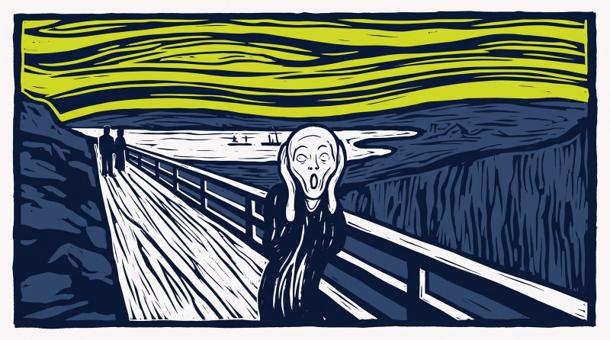
Munch put two figures further down the bridge, entirely untroubled. That is the whole argument in one picture. The one who is screaming is not the one in danger.
The launch problem, specifically

Everything above gets worse when you are launching, because a launch is the one situation where you genuinely do not know the range.
An established product in a known market has a history. You can describe its distribution because you have watched it draw from that distribution forty times. A launch has no history. You are not estimating where you will land inside a known range. You are guessing at the shape of a range nobody has measured.
Which has three practical consequences most launch plans ignore.
Benchmarks from your category do not apply to you yet. They describe companies with brand equity, an install base and search demand you have not built. Using them as your plan is borrowing somebody else’s distribution.
The first launch is not a result, it is a measurement. One draw tells you very little about the underlying distribution, which is why a disappointing first campaign is weak evidence that the strategy is wrong and a spectacular one is weak evidence that it is right. Marks would say the outcome does not tell you what the risk was.
Your survivable range matters more than your target. The right question before a launch is not what success looks like. It is how many disappointing outcomes in a row you can absorb before you have to stop. That number, not the forecast, decides whether the strategy is available to you at all.
So what is risk, then?
Marks’s own definition is narrow and useful.
Risk is the possibility that, out of a range of uncertain outcomes, an undesirable one turns up.
And he splits undesirable in two, where most people only count one half.
It can be the permanent loss of capital when bad things happen. Every business tracks that half.
It can also be missing out on gains when good things happen. Almost nobody puts that one on a risk register, and it is the half that quietly decides which companies still matter in ten years.
Put those together and something uncomfortable falls out. The cautious option is not the low-risk option. It is a different risk, with a slower fuse and no incident report attached.
The company that never repositions has not avoided risk. The one that waits for more data before committing to a category has not avoided risk. The one that keeps running the campaign that still works rather than building the next one has not avoided risk. They have all picked the variety that does not trigger a meeting, and it compounds silently for years before anybody names it.
What I got wrong about this, on two continents
I should be honest about where this landed for me, because I did not read it in a book and nod.
I started Brave New after 8 years working in television, media and investment, and the business has since had to work across Europe, the Gulf, North America. Moving an agency between markets teaches you the Bernstein lesson faster than any memo will, because the range you were working with in one country is not the range in the next one. The benchmarks do not travel. The sales cycle does not travel. What counts as a normal response rate does not travel.
What I had done was forecast a point. What I got was a draw from a distribution I had not bothered to describe, in a market whose range I did not actually know. Bernstein’s second sentence, arriving at my expense.
I do not think that experience made me smart. It made me suspicious of single numbers, which is a cheaper form of the same thing.
Four things to do on Monday
Ask for the range, not the number. When someone brings you a forecast, a media plan or a launch projection, the question is not how confident they are. It is what the spread looks like and what sits outside it. No range means you have been handed a guess in a suit.
Name what you cannot survive. Expected value is a bad guide when one tail is fatal. Before any significant commitment, ask which outcomes end the conversation permanently, and whether you could carry them.
Audit the things nobody worries about. The channel, client, message or asset with no recent incidents is where risk awareness has quietly decayed. That is where your next surprise is currently being assembled.
Put inaction on the register. If missed gains count as risk, then “we decided to wait” is a position with a price, not the absence of one. Write it down next to the others. It looks very different sitting beside them.
None of this makes the future knowable. That is the whole point. Marks’s phrasing is that the goal is to do the best possible job of investing in the absence of that knowledge.
Swap in your own word for investing. Launching. Repositioning. Hiring. Spending. It still works.
Why this matters more now than it did five years ago
A closing note on why we spend our time on this.
Execution has been commoditised. AI writes, designs, edits and ships at close to zero marginal cost, and roughly two thirds of marketing tasks are being absorbed into it. What has not commoditised is the decision underneath: who to target, what to stand for, what to say, and why anyone should care.
Every one of those decisions is made under exactly the uncertainty these three articles describe. More things can happen than will happen. The plan describes one of them. Nobody knows the range.
Here is the part that worries us. AI does not reduce that uncertainty. It reduces the feeling of it. It returns a confident, well-structured, immediately plausible answer to a question whose real answer is a distribution. Article three has the number for what that does: 85% of marketers say they can measure return holistically and 32% actually do, and a 53 point gap between confidence and competence does not make people careful. It makes them decisive.
So the scarce skill is not producing more. It is judgement. Knowing which of the possible outcomes you could not survive. Knowing which number in the deck is a range wearing a disguise. Knowing that the channel nobody worries about is where the exposure now sits.
That is what business knowledge actually is, and it is why we start every engagement with the commercial reality rather than the creative brief. A good model cannot rescue a bad strategy. It only gets you lost faster, and it does it fluently.
We hold the reins. The machine can generate a hundred plans. Only a person can say which one you could afford to be wrong about.
Brave New protects high-stakes companies from the biggest risk of the AI age: sounding like everyone else. We are the strategy-led growth partner for industrial, supply chain, real estate and capital, keeping operationally excellent companies distinctive, credible, and impossible to forget. AI made sameness free. We keep you off the template. Serious is not the same as boring.
Written by Anne Becheru. Reply to this, I read every one.
Risk, in three parts: 1. More things can happen than will happen · 2. You cannot see risk, only the price · 3. Is bravery worth more than brains?
Frequently asked questions
How should a business think about risk in marketing? Not as the chance a campaign fails, but as the fact that several outcomes are possible and your plan only describes one of them. That reframe changes what you ask for: a range rather than a target, an explicit statement of which outcomes you could not survive, and a note of what waiting is costing you.
Why are marketing forecasts usually wrong? Because they present a single point where reality is a distribution. Even professional economists, with better data and stronger incentives, have a poor record of calling turning points. Across 77 countries in 2008, thirteen recessions arrived and none had been forecast by April.
Is a conversion rate or industry benchmark a prediction? No. It describes the universe of outcomes. You experience one draw from it. A 3% average conversion rate tells you nothing reliable about this specific campaign, and category benchmarks are especially misleading for a launch because they describe companies with brand equity you have not built yet.
Why can expected value be misleading in a business case? Because the average of the possible outcomes is often not one of the possible outcomes. If a pitch is worth the whole year or nothing, the expected value of half the year is the one result that cannot occur. Worse, a high expected value can pull a company into a bet whose downside it cannot survive.
Is playing it safe actually low risk for a business? Not in Howard Marks’s definition, which counts missing out on gains alongside permanent loss. A company that never repositions, never launches and waits for more data has not avoided risk. It has chosen the kind that does not generate an incident report.
- Elroy Dimson, London Business School, quoted throughout Howard Marks's work including the risk chapter of The Most Important Thing (Columbia Business School Publishing).
- Howard Marks, How To Think About Risk, presentation to the CalPERS board, January 2025. Source of the four propositions, the Super Bowl example, the Chris Geczy line, the expected-value inversion and the definition of risk.
- Peter Bernstein, quoted by Marks in Risk Revisited Again, Oaktree Capital, 8 June 2015.
- Hites Ahir and Prakash Loungani, IMF, on forecast performance during the Great Recession, using Consensus Economics data across 77 countries. Loungani's earlier finding on the record of failure appears in the International Journal of Forecasting, 2001.
- The SUV example and "there are few things as risky as the widespread belief that there's no risk" appear in The Most Important Thing Illuminated.

Anne leads content, strategy and SEO across the Brave New client roster.