
A falling price makes an asset safer and everyone calls it risky. A rising price makes it more dangerous and everyone calls it good. The same mistake shows up in B2B buying: an unknown supplier is not competing on quality, they are competing while carrying a risk premium the buyer has silently added to their quote.
Article 2 of 3 on risk. Also in this series: More things can happen than will happen · Is bravery worth more than brains?
Here is the awkward thing about pricing risk. You cannot see it.
You can see an outcome. You cannot see the risk that produced it, because the risk was the whole set of things that could have happened, and all but one of them did not. A company that survived a reckless year looks identical, in the accounts, to one that survived a careful year.
Marks puts it this way: risk is hidden and deceptive. Loss is what happens when risk meets adversity. No adversity, no loss, and the risk was sitting there the entire time with nothing to show for itself.
So everyone does the only thing available. You cannot measure risk, so you read it off the price. And the reading is upside down.
Why does risk feel highest when it is lowest?
Marks is blunt about the direction. As an asset falls, most people say it has become risky, look at it dropping. But the lower price has made it less risky, not more. As it rises, people say it is a great asset, look how well it is doing. The rising price has made it riskier.
This is not a clever paradox. It falls straight out of the definition. If risk is the possibility of an undesirable outcome, then what you paid decides how much room you have before an outcome becomes undesirable. Pay less, more futures are survivable. Pay more, fewer are. The asset did not change. Your margin for being wrong did.
The market gets this backwards anyway, in every asset class, in every decade. Marks calls risk perverse and says this perversity is one of the main reasons most people never really understand it.
The commercial version is not subtle. The moment a category is agreed to be safe, it gets priced as if nothing can go wrong, which is exactly when the largest number of things can go wrong at once.

What are buyers actually pricing when they price you?
Now point this at your own business, because the same mechanic is running in every deal you lose.
A buyer compares two suppliers and picks the more expensive, more familiar one. The usual explanation is brand preference. That is not what is happening. The buyer is pricing risk, and specifically their own.
In high-stakes categories, buyers are not optimising for the best outcome. They are optimising against the worst one, and the worst one is not a failed project. It is a failed project with their name on the recommendation. Rory Sutherland has made this point for years and it holds anywhere the decision is visible. The upside of a good decision goes to the company. The downside of a bad one goes to the person who signed it off.
So an unknown supplier is not competing on quality at all. They are competing while carrying a risk premium the buyer has already added. Everything the buyer cannot verify about you gets converted into a number and charged to you at the moment of decision.
Which reframes what marketing is for in industrial, supply chain, real estate or capital. It is not persuasion. It is risk removal. Every named case study, every published figure with a source attached, every client willing to take a phone call, every piece of work shown rather than described, takes a slice off the premium.
That is the whole mechanism behind what we call Trust Architecture. It is also why we say credibility at the door rather than credibility in the pitch. By the time you are pitching, the premium has already been applied.
There is a number on this, and it is larger than most finance directors expect. Fospha’s 2025 analysis across more than 70 brand and market combinations found that companies putting over 5% of budget into awareness and consideration returned three times better blended return on ad spend. In 85% of cases the link between awareness and average order value was causal rather than coincidental.
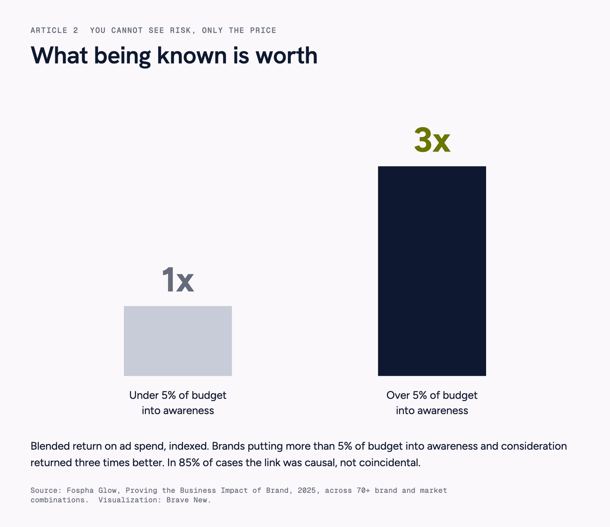
Read that as a risk number rather than a marketing one. Being known is not a vanity purchase. It is how you stop being charged a premium for being unverifiable.
There is a matching number for the other side of it. WARC’s 2026 Multiplier Playbook found B2B carries 46% neutrality, the highest of any category. Nearly half of all business advertising leaves the viewer feeling nothing whatsoever.
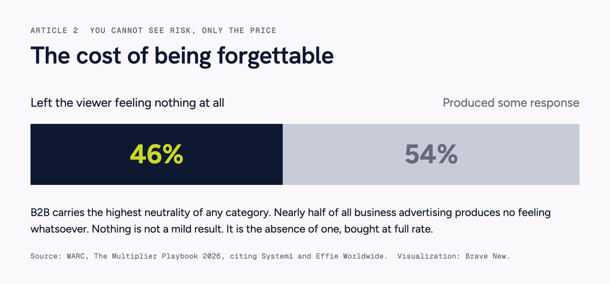
Nothing is not a mild result. A negative reaction at least got processed and stored. Neutrality means the message arrived, was discarded, and you paid the full rate for delivery. For a buyer trying to work out whether you are safe to choose, forgettable and unverifiable are the same condition.
The year I was the risk premium
I want to be specific here rather than theoretical, because I have been on the expensive end of this.
For eight years I worked inside television, media and investment. In all three, the institution does the vouching for you. You walk into a room and the name on the card has already answered the only question that matters, which is whether you are safe to deal with. Nobody is assessing your judgement yet. They are assessing whether choosing you could go wrong for them, and something larger than you has already answered it.
Then I started Brave New and began working across Europe, the Gulf and North America, and found out what that name had been doing for me.
For a long time I read that as a pricing problem. It was not. It was an evidence problem wearing a pricing costume. The fix was not a better proposal. It was making the things they could not verify verifiable, which took much longer and worked much better.
We also did the thing I now warn clients about. We spent years doing the work and almost no time telling anyone about it. That was a choice, and looking back it was the wrong one, because silence does not read as modesty to a buyer. It reads as unverifiable, and unverifiable has a price.
Why cost-plus pricing is really a risk error
Ron Baker’s case against cost-plus pricing is usually filed under value. It is also a risk argument, and the risk version tends to land better with finance people.
Your costs are knowable. That is precisely why they are the wrong basis for a price. You are pricing the only part of the transaction with no uncertainty in it, and giving away the part that carries all of it.
What the buyer is actually purchasing is a change in their range of outcomes. The gardener in Baker’s story who asks what the client plans to do with the house is not gathering requirements. He is working out which uncertainty the client wants removed. Once the answer is “I am selling in two years”, the job stops being garden maintenance and becomes an intervention in the sale price of a property. The price follows the size of that, not the hours.
Cost-plus prices your inputs. Value prices their futures. The gap between the two is risk you absorbed and forgot to invoice. We have gone further into this in Reassuringly Expensive and How to talk about your value.
Does discounting damage a brand?
If a buyer’s price is partly a risk premium, then a discount is a signal about risk, and not the signal you meant to send.
David Aaker’s account of Kraft in the 1980s is the cleanest case anyone has, and we have written it up properly in The 8% Trap. The short version: scanner data made promotions measurable while brand building stayed unmeasurable, the budget moved to the measurable half, and the brand took three years to recover.
Read that as a risk story rather than a marketing one. The company optimised the outcome it could see and accumulated an exposure it could not. Nothing showed up in the numbers until the numbers were the problem.
That is Marks’s point about risk being invisible until adversity arrives, playing out in a grocery aisle over a decade.
Three things this changes
Stop treating a lost deal on price as a price problem. It is usually a risk-premium problem. The useful question is not whether you were too expensive. It is what they could not verify, and what that cost you.
Price the range, not the hours. Work out which uncertainty the buyer is paying to remove and how big it is for them. That number has nothing to do with your cost base.
Watch what your safest revenue is doing to your risk. The client who always renews. The product that always sells. Perceived safety is where risk awareness goes to die, and it is where the next surprise is currently being assembled.
Marks’s line for the discipline is the one worth keeping. Superior investing is based on risk control, not risk avoidance.
The goal was never to carry less risk. It was to be paid properly for the risk you chose, and to know which ones you were carrying.
Most companies are not overpaying for risk. They are carrying it for free.
Why this matters more now than it did five years ago
A closing note on why we spend our time on this.
Execution has been commoditised. AI writes, designs, edits and ships at close to zero marginal cost, and roughly two thirds of marketing tasks are being absorbed into it. What has not commoditised is the decision underneath: who to target, what to stand for, what to say, and why anyone should care.
Every one of those decisions is made under exactly the uncertainty these three articles describe. More things can happen than will happen. The plan describes one of them. Nobody knows the range.
Here is the part that worries us. AI does not reduce that uncertainty. It reduces the feeling of it. It returns a confident, well-structured, immediately plausible answer to a question whose real answer is a distribution. Article three has the number for what that does: 85% of marketers say they can measure return holistically and 32% actually do, and a 53 point gap between confidence and competence does not make people careful. It makes them decisive.
So the scarce skill is not producing more. It is judgement. Knowing which of the possible outcomes you could not survive. Knowing which number in the deck is a range wearing a disguise. Knowing that the channel nobody worries about is where the exposure now sits.
That is what business knowledge actually is, and it is why we start every engagement with the commercial reality rather than the creative brief. A good model cannot rescue a bad strategy. It only gets you lost faster, and it does it fluently.
We hold the reins. The machine can produce infinite content. Only a person can decide what a buyer needs to see before they stop charging you a premium for being unknown.
Brave New protects high-stakes companies from the biggest risk of the AI age: sounding like everyone else. We are the strategy-led growth partner for industrial, supply chain, real estate and capital, keeping operationally excellent companies distinctive, credible, and impossible to forget. AI made sameness free. We keep you off the template. Serious is not the same as boring.
Written by Anne Becheru. Reply to this, I read every one.
Risk, in three parts: 1. More things can happen than will happen · 2. You cannot see risk, only the price · 3. Is bravery worth more than brains?
Frequently asked questions
Why do buyers choose a more expensive supplier they already know? They are pricing their own risk, not yours. In categories where a wrong choice is visible, the buyer’s real exposure is not a failed project but a failed project attached to their recommendation. Familiarity reduces that exposure, so they pay for it.
What is a risk premium in B2B sales? It is the amount a buyer silently adds to an unfamiliar supplier’s price to account for what they cannot verify. It never appears on a quote and it is rarely discussed, but it decides a lot of deals.
How do you reduce the risk premium a buyer charges you? By making the unverifiable verifiable. Named case studies, figures with sources attached, references who will take a call, and work shown rather than described. Each one removes a slice of what the buyer is guessing about.
Is cost-plus pricing wrong? It prices the one part of the transaction with no uncertainty in it. The buyer is not purchasing your inputs, they are purchasing a change in their range of outcomes, and that has no relationship to your cost base.
Does discounting damage a brand? Not in a single sale. Over time it trains customers to buy only on promotion, which erodes pricing power. David Aaker’s account of Kraft in the 1980s is the clearest case: measurable promotions ate the unmeasurable brand, and recovery took three years.
- Howard Marks on the perversity of risk, risk being hidden and deceptive, and risk control versus risk avoidance: How To Think About Risk, CalPERS board presentation, January 2025, and Risk Revisited Again, Oaktree Capital, 8 June 2015.
- David Aaker on Kraft and the move from image advertising into promotion: 20 Principles That Drive Success, Berkeley Haas Alumni Network, 2014.
- Ron Baker on subjective value, cost-plus pricing, and the gardener who asked questions before quoting.
- Rory Sutherland on buyers optimising against the visible downside of a wrong decision.

Anne leads content, strategy and SEO across the Brave New client roster.