
It says IQ predicts income but not accumulated wealth, that cognitive ability stops explaining much above roughly 60,000 euros a year in at least one large study, and that the people who become entrepreneurs scored high on aptitude tests and broke rules as teenagers. It is the combination that shows up in the data, and the same traits backfire when pointed at the wrong structure.
Article 3 of 3 on risk. Also in this series: More things can happen than will happen · You cannot see risk, only the price
You have read this argument a hundred times. Tim Denning put it as cleanly as anyone:
“When you turn 35 you’ll see the difference between those who took risks and those who didn’t.”
Good line. Also an untested claim about the world, and the kind that is very easy to believe and very hard to check, because everyone making it is by definition still standing.
So let us check it. Not to be awkward. The answer turns out to be more useful than the slogan.
Does IQ predict wealth?
Start with the thing the slogan is arguing against.
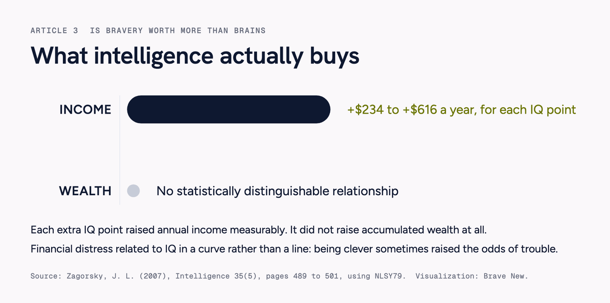
Jay Zagorsky ran a large American cohort study and published it in Intelligence in 2007 under a title that gives the game away: Do you have to be smart to be rich? Each additional IQ point was worth somewhere between 234 and 616 dollars a year in income, holding other factors constant.
So intelligence pays. That part of the folk wisdom survives.
Then he looked at wealth rather than income and found no statistically distinguishable relationship at all.
Higher earnings, no more accumulated wealth. And financial distress, meaning missed payments, maxed cards, bankruptcy, did not fall neatly as intelligence rose. It related to IQ in a curve rather than a line, which is the polite way of saying that being clever sometimes raised the odds of getting into financial trouble.
One study, one country, one cohort. Hold it loosely. But it does establish something worth keeping: what intelligence reliably buys is a better salary, and a better salary is not the same thing as a better outcome.
Does cognitive ability stop mattering at the top?
The more provocative result came out of Sweden in 2023.
Marc Keuschnigg, Arnout van de Rijt and Thijs Bol got hold of something researchers almost never get: cognitive test results from compulsory military conscription for 59,000 men, matched to their later earnings. Because the test was compulsory, nobody selected into it.
The ability-to-wage relationship was strong for most of the distribution. Then it stopped. Above roughly 60,000 euros a year, average cognitive ability flattened at about one standard deviation above the mean and stayed there. More striking, the top one percent of earners scored slightly worse than the people in the brackets just below them, despite earning more than double.
Plainly: past a certain income, knowing what somebody earns tells you very little about how clever they are.
That is the study the internet loves. It is also the one that gets screenshotted without the next paragraph.
The next paragraph
In 2025, researchers ran the same analysis on comparable administrative data from Finland and Norway. Two countries institutionally very similar to Sweden.
They did not replicate the plateau. They found the opposite. The ability-earnings curve kept rising at the top and got steeper.
I am including this because leaving it out would be the easy thing to do, and this whole series is about what happens when you optimise for the number you can see. The plateau is a better story. But a finding that does not hold across three neighbouring Nordic countries is not a law of nature. It is an open question, and anybody selling you the Swedish result as settled is selling you something.
What survives both studies is narrower and still useful. Cognitive ability is a real advantage across most of the distribution, and how much it explains at the very top is contested. Nobody serious thinks it is the only variable up there. That gap is the space the risk argument is trying to occupy.
The study that actually answers it
Which brings us to the best evidence on this, and the reason the whole “risk versus intelligence” framing is wrong.
Ross Levine and Yona Rubinstein published Smart and Illicit: Who Becomes an Entrepreneur and Do They Earn More? in the Quarterly Journal of Economics in 2017. They did something clever. They split the self-employed into the incorporated, meaning people running real businesses, and the unincorporated, meaning everyone else who gets lumped into the same statistics.
The people who became entrepreneurs shared two traits as teenagers. They scored higher on learning aptitude tests. And they engaged in more disruptive, illicit, rule-breaking behaviour.
Not one or the other. Both.
In the authors’ own framing, it is the particular mixture of smart and illicit characteristics that explains who becomes an entrepreneur and what they subsequently earn. And against a lot of earlier research, they found entrepreneurs earned more per hour, not merely more hours.
So the honest answer to “is it risk or intelligence” is that the question contains a false choice. Intelligence with no tolerance for rule-breaking produces a well-paid employee. Rule-breaking with no analytical ability produces chaos. The combination is what shows up in the earnings data.

The finding nobody quotes, which is the important one
There is one more result in that paper, and it should stop anybody turning this into a motivational post.
The same smart-and-illicit people who became unincorporated self-employed took a larger drop in hourly earnings than people without those traits who made the same move.
Identical traits. Helpful in one vehicle. Actively harmful in the other.
That is the real lesson, and it is a risk lesson rather than a personality one. Risk tolerance is not a virtue that pays out wherever you point it. It pays when it is aimed at a structure that can convert it, and it costs you when it is not. The trait did not change. The distribution of outcomes it was aimed at did.
Which is Howard Marks’s argument arriving from an unexpected direction. Risk is not something you possess. It is a property of the situation you have put yourself in.
Why I started Brave New, and what it cost
I am not neutral on this, so I should say where I am standing.
Eight years in television, media and investment taught me the same thing three times. All three industries sell judgement. In all three, the judgement belongs to the platform rather than to the person exercising it. You can be the reason something worked and still have no claim on it afterwards.
Moving a business between continents is the part I would flag for anyone reading this as a risk story rather than an adventure. Each market resets your evidence to zero. Everything you proved in the last country has to be proved again, in a place where nobody can check you, which is precisely the risk premium from the last article, paid repeatedly.
Would I say the risk-taking was the thing that worked? Honestly, no. What worked was that the risk was pointed at a structure that could convert it. When I have pointed the same appetite at the wrong vehicle, it cost me, exactly as Levine and Rubinstein would predict.
That is not a satisfying story. It is the accurate one.
So was Denning right?
Partly, and for the wrong reason.
He is right that not taking risk is itself a position with a cost. Marks’s definition includes both the permanent loss of capital when bad things happen and missing out on gains when good things happen. That second half is real, it is almost never on a risk register, and it compounds silently for a decade before anybody notices. On that, the motivational internet and the most careful risk thinker in finance agree completely.
He is wrong about the mechanism. The evidence does not say bravery beats brains. It says the two multiply, and the multiplication only pays inside a structure capable of converting it. A brave decision in the wrong vehicle is not courage. It is expensive noise.
And there is the thing none of these posts can control for. Everyone making the argument survived it. We never hear from the people who took the same swing and are now quietly employed somewhere, having lost the years. That does not make the advice wrong. It makes the confidence unearned.
Unearned confidence is measurable, and marketing has a number for it. Nielsen asked marketers whether they could measure return on investment holistically, and then asked what they actually did. 85% said they were confident. 32% were doing it.
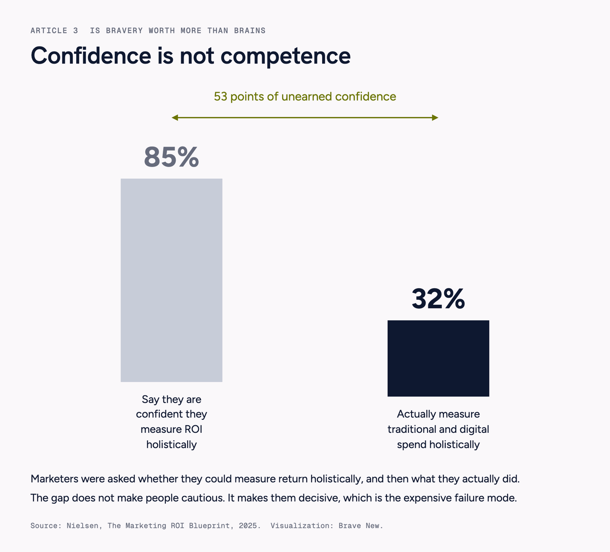
A 53 point gap between what a profession believes about itself and what it does is not harmless, because unearned confidence does not produce caution. It produces conviction, and conviction moves budgets.
Three translations if you run something
Intelligence is table stakes in your category, not an edge. Everyone at the table can read a spreadsheet. Whatever separates the top performers from the merely competent, it is probably not analytical horsepower, and hiring entirely for that is optimising a variable that stopped discriminating a while ago.
Check the vehicle before you praise the courage. Before backing a bold move, the question is not whether the person is brave. It is whether the structure they are operating inside can turn a bold move into a return.
Put “we waited” in the same column as the other risks. If missing gains is a real category of risk, the safe option belongs on the register beside the dangerous ones, priced. It stops looking safe once it is sitting next to them.
Jason Pargin, writing at Cracked in 2012, made the point underneath all of this better than any paper. His parable is a man with a pocket knife standing over a gunshot victim, listing his personal virtues while the bleeding continues. The world does not reward your qualities. It rewards what you can do for people who need something.
Risk tolerance is not a quality either. It is worth something only at the moment it turns into a decision that changes somebody’s outcome.
Everything before that is just a good line about turning 35.
Why this matters more now than it did five years ago
A closing note on why we spend our time on this.
Execution has been commoditised. AI writes, designs, edits and ships at close to zero marginal cost, and roughly two thirds of marketing tasks are being absorbed into it. What has not commoditised is the decision underneath: who to target, what to stand for, what to say, and why anyone should care.
Every one of those decisions is made under exactly the uncertainty these three articles describe. More things can happen than will happen. The plan describes one of them. Nobody knows the range.
Here is the part that worries us. AI does not reduce that uncertainty. It reduces the feeling of it. It returns a confident, well-structured, immediately plausible answer to a question whose real answer is a distribution. Article three has the number for what that does: 85% of marketers say they can measure return holistically and 32% actually do, and a 53 point gap between confidence and competence does not make people careful. It makes them decisive.
So the scarce skill is not producing more. It is judgement. Knowing which of the possible outcomes you could not survive. Knowing which number in the deck is a range wearing a disguise. Knowing that the channel nobody worries about is where the exposure now sits.
That is what business knowledge actually is, and it is why we start every engagement with the commercial reality rather than the creative brief. A good model cannot rescue a bad strategy. It only gets you lost faster, and it does it fluently.
We hold the reins. The machine will give you the confidence. It will not give you the judgement, and the judgement is the only part that was ever scarce.
Brave New protects high-stakes companies from the biggest risk of the AI age: sounding like everyone else. We are the strategy-led growth partner for industrial, supply chain, real estate and capital, keeping operationally excellent companies distinctive, credible, and impossible to forget. AI made sameness free. We keep you off the template. Serious is not the same as boring.
Written by Anne Becheru. Reply to this, I read every one.
Risk, in three parts: 1. More things can happen than will happen · 2. You cannot see risk, only the price · 3. Is bravery worth more than brains?
Frequently asked questions
Does IQ predict wealth? It predicts income better than wealth. Jay Zagorsky’s 2007 study found each IQ point worth 234 to 616 dollars a year in income, but no statistically distinguishable relationship with accumulated wealth, and financial distress that related to IQ in a curve rather than a line.
Do the highest earners have the highest cognitive ability? Contested. A 2023 Swedish study of 59,000 conscripts found ability plateauing above roughly 60,000 euros a year, with the top one percent scoring slightly lower than the brackets below. A 2025 study using comparable Finnish and Norwegian data failed to replicate that and found the opposite.
What actually predicts entrepreneurial success? In Levine and Rubinstein’s 2017 study, the strongest predictor was a combination: scoring high on learning aptitude tests as a teenager and engaging in more rule-breaking behaviour. Neither trait alone did the work.
Is risk-taking always an advantage? No, and the same paper shows it. The identical smart-and-rule-breaking traits that raised earnings for people who built incorporated businesses produced a larger earnings drop for those who went unincorporated. The trait is only worth something pointed at a structure that can convert it.
Is playing it safe a real risk? Yes, under Howard Marks’s definition, which counts missing out on gains alongside permanent loss of capital. The cautious option has a cost, it just does not generate an incident report.
- Jay L. Zagorsky, "Do you have to be smart to be rich? The impact of IQ on wealth, income and financial distress", Intelligence, vol. 35 issue 5, 2007, pages 489 to 501.
- Marc Keuschnigg, Arnout van de Rijt and Thijs Bol, "The plateauing of cognitive ability among top earners", European Sociological Review, vol. 39 issue 5, 2023, pages 820 to 833. Swedish conscription data, 59,000 men.
- The Finnish and Norwegian replication attempt, published 2025, which found the opposite pattern and a steepening ability-earnings curve at the top. Included deliberately, because the Swedish result is contested rather than settled.
- Ross Levine and Yona Rubinstein, "Smart and Illicit: Who Becomes an Entrepreneur and Do They Earn More?", Quarterly Journal of Economics, vol. 132 issue 2, 2017, pages 963 to 1018.
- Howard Marks on risk including missed gains: How To Think About Risk, CalPERS board presentation, January 2025.
- Tim Denning, post on X, August 2026.
- Jason Pargin, writing as David Wong, "6 Harsh Truths That Will Make You a Better Person", Cracked.com, 2012. Quoted by Denning in that post.

Anne leads content, strategy and SEO across the Brave New client roster.