Awareness held. Traffic held. Intent held. Revenue tripled between fiscal 2019 and fiscal 2026 and the share price still fell by more than half, because the company did not put enough new reasons in front of the intent it had already paid for. Management named the failure itself, on a call, in its own marketing language, and called it newness. It was five quarters late, and lateness is what costs the multiple.
Priced In, article 2. Also in this series: #1 Nike, the company that stopped paying for attention
Priced In is a series about marketing decisions that were eventually priced by the market. One named company, one documented decision, the verdict charted. The rule is that management has to have said something on the record at the time, because otherwise all any of us are doing is telling stories about charts.
“They were there with intent to spend.”
A chief executive said that on an earnings call, about his own customers, as an explanation for why revenue was falling.
Read it again, because it is the whole article. The traffic arrived. The people wanted to buy something. And there was not enough worth buying.
On 3 September 2026 Lululemon reported a quarter in which revenue fell 4% to $2.42 billion and comparable sales fell 9%. In the Americas, revenue fell 8% and comparable sales fell 12%, the fifth consecutive quarter of decline in the region that is the core of the business. The company cut its full-year forecast for the second time this year, to $10.35 to $10.5 billion, a decline of 5 to 7%.
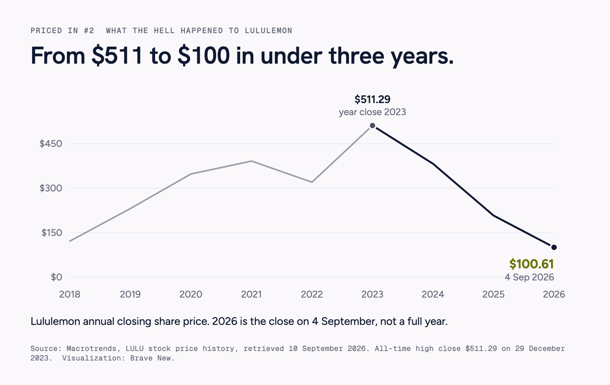
The next day the stock fell 17.4% to $100.61, having traded as low as $97.99, under a hundred dollars for the first time since 2018.
The chart that makes this a marketing story
Here is what separates Lululemon from an ordinary retail decline, and it is the reason I am writing about it at all.
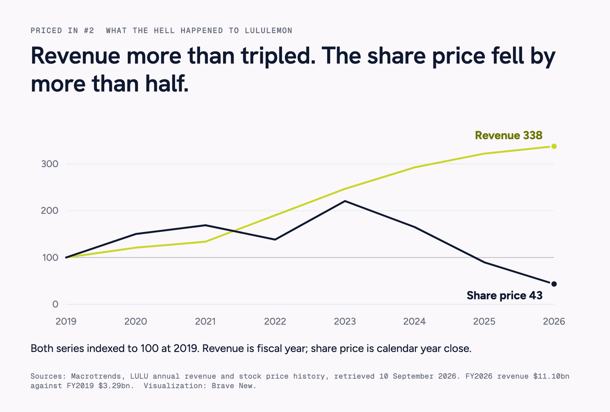
Revenue did not collapse. Revenue tripled. Fiscal 2019 to fiscal 2026, $3.29 billion to $11.10 billion. Index it to 100 and revenue finishes at 338.
The share price, indexed the same way, finishes at 43.
The price to earnings ratio tells the same story more brutally. In October 2023 the market paid roughly 50 times earnings for this company. In September 2026 it pays about 8.
Nothing in the accounts explains that. A business whose revenue tripled does not lose eighty per cent of its valuation because of arithmetic. It loses it because the market stopped believing in the thing that was producing the arithmetic, and that thing is not on any statement.
What the company said the problem was
This is the unusual part, and it is why Lululemon is a better case study than Nike. Management named the failure out loud, in public, on a call, in marketing language.
The word they used is newness.
Calvin McDonald, then chief executive, described it as the seasonal updates to colour, print, pattern and silhouette. And then he said this:
“It’s become clear to us that this reduced newness, which is below our historical level, and stems from earlier product decisions, has impacted conversion rates, given the fewer new options available to our female guests.”
And: “The newness that we had performed well. We simply did not have enough to inspire her to purchase.”
Three things are admitted there and each one is worth a meeting.
Awareness was intact. Traffic was intact. Intent was intact.
The problem was upstream, in “earlier product decisions”, which means the shortfall was authored a year or more before it appeared in a comparable sales number.
And the mechanism was conversion. Not acquisition. People arrived and left.
Two ways to go bankrupt on a brand
In part one I argued that Nike ran up voice debt: it stopped paying for attention, took the margin, and had the bill read out by the market.
Lululemon did the opposite thing and got a similar answer, which tells you something about the underlying asset.
Nike stopped being wanted. It reduced brand investment and left the shelves where preference is formed, so the demand simply stopped arriving.
Lululemon stopped being worth wanting. It kept the brand, the community, the stores, the traffic, the intent. And then it did not put enough new reasons in front of that intent, and the intent went and spent itself somewhere else.
The second is worse, and here is why. In the first case you stop paying for demand you were not going to receive. In the second you pay full price for the traffic and then fail to convert it. You are funding the top of the funnel and leaking at the bottom, and every efficiency metric you own will tell you your marketing is getting worse, when your marketing is fine and your product calendar is the problem.
For a premium repeat-purchase brand, newness is not merchandising. It is the renewal mechanism of the brand itself. A customer’s reason to return is not that she remembers you. She remembers you. Her reason to return is that there is something there she has not seen.
Mental availability without a reason to come back is traffic you have paid for twice.
Read the components, not the headline
One more number from that quarter, because it is a small masterclass in how a good figure can be a bad figure.
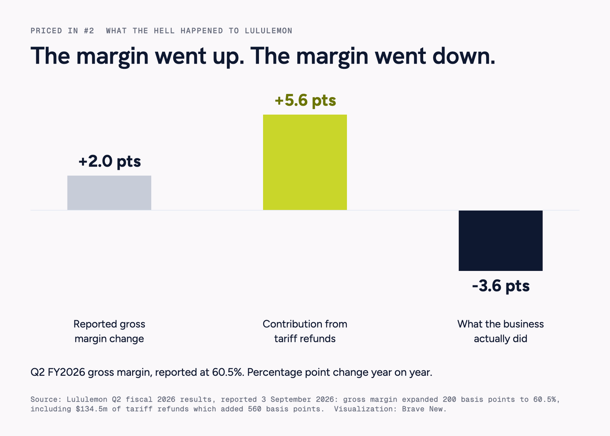
Gross margin was reported at 60.5%, up 200 basis points year on year. Excellent, on the face of it, in a quarter when everything else fell.
Except that the figure included $134.5 million of tariff refunds, which added 560 basis points on their own.
So the reported improvement is 200 points. The one-off contribution is 560 points. Which means the underlying business ran roughly 360 points worse, in a quarter that was already down on revenue, comparable sales and operating income.
Nobody hid this. It is in the release. It simply requires opening the number rather than reading it, which is the entire skill I keep writing about, and this is what it looks like when it is worth about four hundred million dollars of market value.
The enemy, named by the founder in a full-page advertisement
In part one I said the enemy is not a person, it is a condition: marketing is judged by what can be counted before the person who approved it moves on.
Lululemon’s founder said the same thing, less politely, in the Wall Street Journal.
Chip Wilson took out a full-page advertisement headlined “lululemon: In a Nosedive”, accusing the board of favouring “operator/finance CEOs who can ‘speak Wall Street’” over product-driven leadership, and saying the brand had lost its edge. There was a proxy fight. It has since been settled.
You do not have to agree with Wilson about anything else to notice that he described the mechanism accurately. A leader selected for fluency in quarterly explanation will optimise for what can be explained quarterly. Newness cannot. A product calendar is an eighteen-month instrument being run by people appraised on ninety-day cycles.
Which is exactly the Nike sentence with different nouns in it.
And then both companies reached for the same answer
Calvin McDonald stepped down, leaving the chief executive role and the board on 31 January 2026 and staying as an adviser until the end of March. The chief financial officer and the chief commercial officer ran the company as interim co-chief executives. The board chair took an expanded role as executive chair.
The permanent replacement is Heidi O’Neill, who arrived from Nike.
Sit with the symmetry for a second. Nike, having concluded that an outsider from technology had misread a product-and-culture business, brought back a thirty-two year insider. Lululemon, having concluded something similar about finance-led leadership, hired from Nike.
Both boards diagnosed the same disease. Both prescribed proximity to the product.
Neither has yet produced a quarter that proves it works, which is the part of this story nobody wants to publish, because “correct decision, insufficient time” is not a headline.
What this costs, in the only unit that matters
Lululemon is now valued at roughly $11 billion, against a 52-week high share price of $225.98 and a current price near $100. Citigroup maintained a Neutral rating on 9 September and cut its target from $130 to $117.
The company also paused sales of its Breezethrough line in late July, which McDonald described as having negligible impact on the quarter but the right step, with the fabric to be reintroduced later. It cut around 150 corporate roles. Tariff changes on Chinese imports and the removal of some de minimis relief were expected to take roughly $210 million off operating income and about 390 basis points off operating margin.
All of that is real, and none of it is the story. The story is that a company can grow revenue every single year, keep its cultural position, retain its traffic, and still lose eighty per cent of its value, because the market is not pricing what you sold last quarter. It is pricing whether you will still be wanted in three years.
What I would have done, with the same disclosure
I sell communications for a living, so I am the last person whose advice on this you should take uncritically. Here it is anyway.
On branding. In a premium repeat-purchase category, newness is not merchandising. It is the renewal mechanism of the brand, and it belongs on the same page as awareness and pricing power, reported at board level, with a name and an owner. Lululemon discovered its newness rate had fallen below historical levels by reading its own conversion data after the fact. That is a smoke alarm installed after the fire.
On marketing. They had a conversion problem and the reflex in almost every company facing falling sales is to buy more traffic. When intent is arriving and not converting, more traffic makes the number worse and the diagnosis harder, because you are now paying to prove the same point twice. The correct move is to stop buying attention you cannot serve, and spend the difference on the reason to return.
On investor communications, which is again where the value was lost fastest. The Americas fell for five consecutive quarters before the newness explanation was given in full. The explanation, when it arrived, was excellent: specific, unflattering, in the company’s own language, with a remediation plan attached.
It was also very late, and lateness is what costs the multiple.
Markets do not punish bad news at anything like the rate they punish surprise. A company that names its own problem in quarter one, dates the fix and reports against it every quarter is having a difficult conversation. A company that explains the same problem in quarter five is having a credibility conversation, which is priced differently and takes far longer to leave.
And there is a harder rule underneath it, which I would put in front of any board. Never let the founder be the person who names your problem in a full-page newspaper advertisement. By the time somebody outside the company describes your business better than you have, the disclosure question has already been decided for you.
The same rule as part one, restated. The market does not price your results. It prices your explanation of them, discounted by how often that explanation has been wrong before.
Four questions, for a company that is not Lululemon
When our conversion rate falls, do we check the product calendar before we check the ads? Almost nobody does. The first meeting is always about traffic and creative, because those have owners in the room. The product decision that caused it was made eighteen months ago by people who have since been promoted.
What is our newness rate, and does anybody own it as a number? Percentage of revenue from things that did not exist a year ago. If you cannot produce it this week, you are running a repeat-purchase business without a repeat-purchase metric.
Are we confusing loyalty with inertia? A customer who keeps arriving is not the same as a customer who keeps buying, and the gap between those two is the most flattering number in retail right up until it closes.
And which of our good numbers this quarter had a one-off inside it? Somebody in your business already knows. They are usually not invited to the meeting where the number gets celebrated.
Nike forgot that you have to keep paying for attention.
Lululemon remembered that, and forgot the other half: that attention is a loan against a promise, and the promise has to be renewed with something the customer has not seen before.
She was there. She had her card out. That is the most expensive sentence in retail, and it took a chief executive to say it out loud before anybody drew the chart.
Part one of this series, on Nike, is here. Anne Becheru runs Brave New, a B2B communications agency working across the US, the EU and the Middle East. She writes the Brave New Business Journal every Tuesday.
About this series
Priced In takes one named company, one documented marketing or brand decision, and what the market did next.
The enemy is the same in every episode, and it is not a person. Marketing is judged by what can be counted before the person who approved it moves on. Every company in this series contained rational people operating correctly inside a measurement window shorter than the mechanism they were operating.
Five rules I hold myself to, because it is very easy to explain a share price after the fact and call it analysis:
- Use what management said at the time. Calls, filings, transcripts. Commentator hindsight is not evidence.
- Source every figure with its date. Where two published figures disagree, both go in and the disagreement is part of the story.
- Open the components. A headline number containing a one-off is not a number, it is a shape.
- Never claim a single cause. Tariffs, cycles and competitors get named. The argument is what the marketing decision removed, and why there was nothing left to absorb the shock.
- Admit the limitation before the strongest claim.
Episodes so far. #1 Nike, the company that stopped paying for attention. #2 Lululemon, the company that kept the attention and had nothing to give it.
Suggest the next one. Reply with a company whose share price and marketing behaviour diverged in a way you think is interesting, and why. Management has to have said something on the record about it.
Sources
- Results. Lululemon quarterly results reported 3 September 2026: revenue down 4% to $2.42 billion; comparable sales down 9%; Americas net revenue down 8% and Americas comparable sales down 12%; international net revenue up 4%, up 2% on a constant dollar basis; diluted EPS $2.92 against $3.10; net income $329.2 million against $370.9 million; income from operations down 13% to $453.7 million; gross margin up 200 basis points to 60.5%, including $134.5 million of tariff refunds contributing 560 basis points. Full-year guidance cut a second time to net revenue of $10.35 to $10.5 billion, a decline of 5 to 7%, and adjusted EPS of $9.48 to $9.73. Reported by Quartz, Yahoo Finance, Financial Post and Investopedia. Note: sources label this quarter variously as Q2 fiscal 2026 and Q2 fiscal 2027; the report date is used here instead.
- Share price and valuation. Macrotrends, LULU stock price history, retrieved 10 September 2026: annual closes 2018 to 2025 and the close of $100.61 on 4 September 2026, a fall of 17.38% on the day, with an intraday low of $97.99; all-time closing high $511.29 on 29 December 2023; 52-week high $225.98. Macrotrends PE history: approximately 50 times earnings at 31 October 2023 against approximately 8 times at 4 September 2026. Yahoo Finance, 9 September 2026: market capitalisation approximately $11.0 billion. Citigroup maintained Neutral and lowered its target from $130 to $117 on 9 September 2026.
- Revenue series. Macrotrends, LULU annual revenue: fiscal 2019 $3,288 million rising to fiscal 2026 $11,103 million. Indexed chart notes that revenue is fiscal year and share price is calendar year close.
- Management statements. Calvin McDonald on "newness" and on conversion, from the earnings call transcript quoted by Investopedia via AlphaSense, including "they were there with intent to spend" and "we simply did not have enough to inspire her to purchase". Financial Post on the definition of newness as seasonal updates to colours, prints, patterns and silhouettes, on the reshuffling of product staff, and on the pause of the Breezethrough line in late July 2026.
- Leadership. McDonald stepping down from the chief executive role and the board on 31 January 2026, remaining a senior adviser to 31 March; CFO Meghan Frank and Chief Commercial Officer André Maestrini as interim co-chief executives; board chair Marti Morfitt as executive chair; Heidi O'Neill, a Nike veteran, incoming chief executive from September 2026. Reported by Fox Business and secondary coverage.
- Chip Wilson. Full-page Wall Street Journal advertisement headlined "lululemon: In a Nosedive", quoted in secondary coverage as accusing the board of favouring "operator/finance CEOs who can 'speak Wall Street'" over product-driven leadership; subsequent proxy fight since settled. This detail comes from secondary reporting rather than the advertisement itself and should be verified against the original before republication.
- Other. Approximately 150 corporate roles cut in a reorganisation tied to tariffs and cost control; tariff changes on Chinese imports and removal of some de minimis relief expected to reduce operating income by approximately $210 million and operating margin by approximately 390 basis points, per secondary reporting.

Anne leads content, strategy and SEO across the Brave New client roster.