
It borrowed against its share of voice, one entirely defensible quarterly decision at a time, and took the margin. Cutting brand investment removed the reason people wanted the shoe. Leaving the multi-brand shelves removed the room where that preference is formed. Both halves of availability went at once, every efficiency metric improved on the way down, and more than two years of correct, fully funded repair work has not put it back.
Priced In, article 1. Also in this series: #2 Lululemon, the company that kept the attention and had nothing to give it
Priced In is a series about marketing decisions that were eventually priced by the market. One named company, one documented decision, the verdict charted. The rule is that management has to have said something on the record at the time, because otherwise all any of us are doing is telling stories about charts.
I heard it on CNBC, which is where I hear most things.
Nike removed from the S&P 100. Not delisted, and not the S&P 500, which is what half the internet said within the hour. Removed from the index of the hundred largest listed American companies, in a routine reconstitution on 5 September 2026, alongside Simon Property Group. An administrative notice that would have gone unread if it had been almost anyone else.
I put my coffee down, which is not something I do for index reconstitutions.
Because the first professional athlete Nike ever signed was Romanian.
Ilie Năstase, 1972, world number one, known everywhere as Nasty, for a fee reported as five thousand dollars in some accounts and ten in others, both tracing back to the same book. At that point the company was barely a company. The swoosh meant nothing to anyone. And a man selling running shoes out of the back of a car decided that the fastest way to make people want a shoe was to pay somebody to be seen in it.
That is the invention. Not the shoe. Not the logo. The idea that you can buy attention now and collect the demand later.
I grew up in Romania, so Nike was never only footwear to me. It was the first proof I ever saw that marketing could take an object and make it carry power, and beauty, and a kind of permission. I read Phil Knight’s Shoe Dog the way other people read biographies of generals.
Which is why I can be exact about the rest of this. You do not get to write honestly about something you have never admired.
The enemy is not a person
The obvious story is that an outsider CEO broke a great company and an insider came back to fix it. That story is available, it is roughly true, and it is useless to you, because you do not employ John Donahoe.
The enemy in this narrative is not a man. It is a condition, and you work inside it too.
Marketing is judged by what can be counted before the person who approved it moves on.
That is the whole antagonist. Not stupidity, not vanity, not digital. A measurement window that is shorter than the mechanism it is measuring. Every actor in the Nike story behaved rationally inside that window, and the window is what did the damage.
Therefore the interesting question is not what Nike got wrong. It is what the numbers looked like while it was happening, because they looked good.
What the market priced
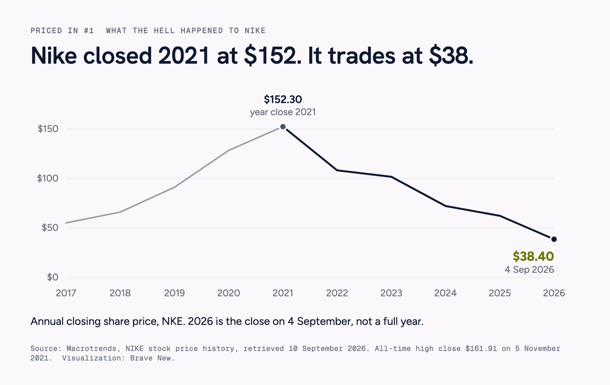
Nike closed 2021 at $152.30, having reached an all-time closing high of $161.91 on 5 November that year. On 4 September 2026 it closed at $38.40. The reported loss in market value runs between $190 billion and $220 billion depending on which peak you measure from, which is a thirty billion dollar disagreement between two defensible published figures, and I mention it only so you know I checked.
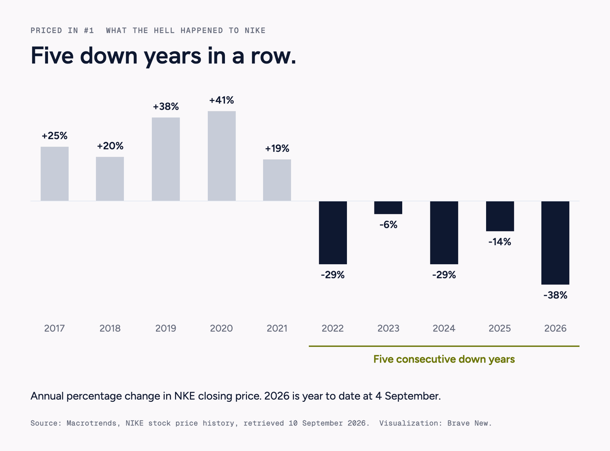
Five consecutive down years. Down 29%, 6%, 29%, 14%, and 38% so far this year.
But awareness did not collapse in that time. Recognition did not collapse. Ask anyone on any continent to draw a sports logo and you will still get a swoosh.
Therefore what fell was not fame. What fell was the market’s belief about what that fame would be worth later, which is a different asset entirely, and one nobody has on a balance sheet.
Stop saying brand budget
Here is the single change I would make in your next planning meeting, and it costs one word.
Do not say brand budget. Say share of voice.
A budget is a cost line. It sits beside other cost lines, it gets compared to them, and in a hard quarter it loses that comparison, because it is the only line that cannot show you what it bought.
Share of voice is a competitive position. It is your percentage of everything spent talking in your category, measured against your percentage of everything sold in it.
Same money. Entirely different conversation. A finance director will cut a budget without blinking and will not cut a position, because a position has a competitor standing in it.
Voice debt
Now the mechanism, and it needs a name, because a problem nobody can say out loud cannot be argued about in a meeting.
Call it voice debt.
You borrow against your share of voice by spending less than your size warrants. The borrowing is invisible, the proceeds arrive immediately as margin, and the repayment schedule is set by your competitors rather than by you.

The evidence is not mine. In 2013 Les Binet and Peter Field published The Long and the Short of It for the IPA, built on 996 case studies, 700 brands, 83 categories, thirty years of data.
Three findings carry this piece.
The 60/40 split. Campaigns putting roughly 60% of budget into brand building and 40% into sales activation produced the best long-run results. In B2B the balance moves to roughly 46% brand and 54% activation, because the buying is more rational and more relationship-led. Neither number is anywhere near everything-into-the-measurable-half.
Excess share of voice. ESOV is share of voice minus share of market. Work by Danenberg, Kennedy, Beal and Sharp at the Ehrenberg-Bass Institute put a figure on it: roughly every 10 points of excess share of voice buys about half a point of market share per year.
And it runs in both directions. Above your share of market, you grow. Below it, you decline. John Philip Jones established the relationship in 1990 and Ehrenberg-Bass quantified it.
Therefore a large brand that goes quiet is not being thrifty. It is running the growth equation backwards, on purpose, at roughly half a point of share a year for every ten points of silence.
Which of the four are you in
Four positions. Everybody is standing in one of them this morning.
Compounding. Voice above market share, brand large. Expensive, unglamorous, and the reason certain companies appear to win without effort.
Buying. Voice far above market share, brand small. This is what a challenger is doing when it feels like they are suddenly everywhere. They are, they are paying for it, and it works.
Harvesting. Voice below market share, brand large. Margin looks excellent. Every efficiency metric improves. Share is being converted into profit at a rate that appears on no slide.
Disappearing. Voice below market share, brand small. Nothing left to harvest.
Harvesting is the dangerous one, because it is the only position that feels like competence the entire time it is happening.
What Nike actually did, and why it was reasonable
Under John Donahoe, only the second outsider ever to run the company, Nike committed to direct-to-consumer. The published ambition was digital rising from 26% of the business in 2023 to 40% by 2025. Selling direct carries better margin, and it hands you the customer data the retailer would otherwise keep. That is not a foolish plan. It is a good plan with one missing input.
To fund it, Nike pulled back from wholesale. Fewer accounts, less shelf, less presence in the multi-brand stores where people go to try shoes on. Product innovation slowed, with more weight on reissuing old winners. And the mix moved from brand building toward performance, which is to say from making somebody want a shoe in eighteen months to converting somebody who wants one today.
Donahoe later told CNBC the company had “over-rotated” away from wholesale, “a little more” than it should have.
But here is what that decision actually did, in the vocabulary that matters.
Byron Sharp’s distinction is two words: mental availability and physical availability. Whether people think of you, and whether they can reach you.
Cutting brand investment reduces the first. Leaving the shelves reduces the second.
Therefore Nike did not make one mistake. It removed both halves of availability simultaneously, in service of a single strategy, and each cut made the other more expensive.
The number that should be on a slide in every marketing department
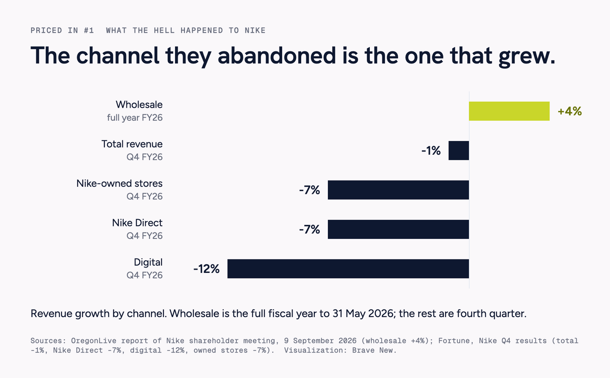
In the fourth quarter of the year ending 31 May 2026, total revenue fell 1% to around $11 billion. Nike Direct, the entire point of the strategy, fell 7%. Digital, the specific number the 40% target was about, fell 12%. Nike-owned stores fell 7%.
Wholesale, the channel deliberately de-prioritised, grew 4% across the year.
A multi-brand store is not only a place where transactions happen. It is a place where somebody who was not looking for you finds you, tries you against three alternatives, and forms a preference.
Therefore leaving it did not cost a distribution point. It cost the room where preference is made, while keeping the room where preference is collected.
You can only harvest what somebody planted.
The limitation, and then the claim
I cannot show you Nike’s share of voice. Nobody outside the company can see the brand-versus-activation split precisely, and the competitive spend data needed to calculate ESOV properly is not public. Anyone claiming to have modelled it exactly is selling you something.
So what follows is inference from a documented strategy and a public result.
Nike’s decline is not a single-cause story. The reporting names tariff costs, a stretched supply chain, weakness in China, a broad cooling in footwear as households moved money toward travel and experiences, and a genuinely better field of competitors. On 9 September 2026 BMO Capital initiated coverage at Underperform with a $30 target, citing sector conditions as much as execution.
All true. And that pile-up is precisely the moment brand equity is supposed to earn its keep. Nobody builds a brand for the good years. You build it so that when tariffs, a soft category and three fast competitors arrive in the same eighteen months, there is enough banked preference that you do not have to discount your way out.
Therefore the macro conditions did not cause the fall. They tested a reserve that had already been spent.
The repayment schedule
In September 2024 Nike brought back Elliott Hill. Thirty-two years inside, an intern in 1988, retired in 2020, passed over for the job the first time. He started in October 2024 and has done the reverse of everything above: wholesale repaired, saturated styles pulled, money back into athletic innovation, the whole company rebuilt around sport under a strategy called Sport Offense.
And it is working where you would expect it to work first. Wholesale up 4%. Running growing double digits for five consecutive quarters, adding roughly $1 billion. At the September 2026 shareholder meeting Hill said he has “growing confidence”, and also, plainly, that “our overall results are not where we need them to be.”
Two years. A veteran with total internal authority, doing correct things, fully funded, board behind him.
Therefore this is the finding, and it is not that the strategy was wrong, which everyone now agrees on. It is the asymmetry of the clock. A few years of reallocation ran the account down. More than two years of competent, expensive, correct work has not put it back, because you are not rebuying media. You are rebuilding what a few hundred million people assume without thinking, and that assumption took forty years to lay down.
You can take on voice debt in a quarter. You cannot repay it on the same schedule. No plan I have ever seen accounts for the gap.
What I would have done, and I say that knowing how cheap it is from here
I run a communications agency. So the honest disclosure is that I am the person who benefits if you conclude that brand spend should not have been cut. Read the rest with that in mind.
On branding. The mistake was not choosing direct-to-consumer. The mistake was classifying distribution as a cost of sale rather than as a brand asset. A multi-brand shelf is paid media that happens to also take payment. If you value it as media, you do not cut it to fund a margin improvement, because you can see what you are giving up. Nike valued it as a margin drag, and margin drags get removed.
On marketing. Hold the split through the transition. A channel shift is not a reason to move the brand-to-activation balance, and if anything it is a reason to raise brand investment, because you are removing a physical availability asset and have to compensate with mental availability or you will feel both losses at once. Nike moved the split in the same direction as the channel change and got the compound effect it deserved.
On investor communications, which is where I think the real error sits. Nike narrated the direct-to-consumer pivot as a margin story. That is the decision I would reverse first, before any of the marketing ones.
A margin story invites the market to check margins quarterly. It sets a clock you cannot win against, because the cost of the transition arrives immediately and the benefit arrives in years. Told as an investment thesis instead, with a stated payback horizon and a named set of leading indicators the company would report against, the same facts produce a different price. Brand tracking. Wholesale sell-through. Share of new customers. Repeat rate by cohort.
Give the market a scoreboard or it will build one, and the one it builds is always quarterly revenue, because that is the number it already has.
That is the general rule under this whole series. The market does not price your results. It prices your explanation of your results, discounted by how often that explanation has been wrong before.
Four questions for your own budget
What share of this year’s growth did we create, and what share did we collect? If you cannot separate them, you cannot tell efficiency from depletion. On a dashboard they are the same picture.
Where do people who are not looking for us encounter us? Nike’s answer used to be a shelf in a shop that also sold four competitors. If your honest answer is nowhere, your entire budget is being spent on people who already know you, which is a closing budget, not a growth one.
Is our share of voice above or below our share of market? You will not get this precisely. Roughly is enough to know which of the four positions you are standing in.
If we cut brand spend tomorrow, when would we find out? Almost never this quarter. Which is the enemy, restated: any cost whose consequence lands eighteen months later gets cut by somebody who will have moved on before it does.
Which is just deferred maintenance
Every industrial company on earth already understands this.

You can stop servicing the line. Output does not drop the next morning. Costs fall immediately, the numbers improve, and the person who signed it off looks correct for several quarters. Then the tolerances go, and the repair costs a multiple of the servicing, and takes longer than anybody wants to hear.
Nobody calls that a saving. Everybody calls it deferred maintenance, and finance has an account for it.
Brand is the same asset with no account. It depletes silently, it produces excellent metrics on the way down, and the bill arrives in a currency you cannot buy back quickly.
Which brings me back to a tennis player from Bucharest in 1972.
Nike did not become Nike by making the best shoe. It became Nike because a man with almost no money worked out that you could pay for attention before you had earned the demand, and that the demand would arrive later, larger, and at a price you could set yourself.
That was the invention. Fifty-four years later, the company that invented it stopped paying for attention, took the margin, and was removed from an index while I was drinking coffee in front of CNBC.
It did not lose $190 billion.
It spent it, one entirely defensible quarterly decision at a time, and then had the bill read out in public by people who never saw the marketing plan.
Anne Becheru runs Brave New, a B2B communications agency working across the US, the EU and the Middle East. She writes the Brave New Business Journal every Tuesday.
About this series
Priced In takes one named company, one documented marketing or brand decision, and what the market did next.
The enemy is the same in every episode, and it is not a person. Marketing is judged by what can be counted before the person who approved it moves on. Every company in this series contained rational people operating correctly inside a measurement window shorter than the mechanism they were operating.
Five rules I hold myself to, because it is very easy to explain a share price after the fact and call it analysis:
- Use what management said at the time. Calls, filings, transcripts. Commentator hindsight is not evidence.
- Source every figure with its date. Where two published figures disagree, both go in and the disagreement is part of the story.
- Open the components. A headline number containing a one-off is not a number, it is a shape.
- Never claim a single cause. Tariffs, cycles and competitors get named. The argument is what the marketing decision removed, and why there was nothing left to absorb the shock.
- Admit the limitation before the strongest claim.
Episodes so far. #1 Nike, the company that stopped paying for attention. #2 Lululemon, the company that kept the attention and had nothing to give it.
Suggest the next one. Reply with a company whose share price and marketing behaviour diverged in a way you think is interesting, and why. Management has to have said something on the record about it.
Sources
- Share price and index. Macrotrends, NIKE stock price history, retrieved 10 September 2026: year closes 2017 to 2025, close of $38.40 on 4 September 2026, all-time closing high $161.91 on 5 November 2021. Removal from the S&P 100 alongside Simon Property Group reported 5 September 2026; market value decline reported as approximately $190 billion to $220 billion depending on measurement basis. Yahoo Finance, 9 September 2026: close $37.35, market capitalisation approximately $55.4 billion. BMO Capital initiated at Underperform, $30 target, 9 September 2026.
- Marketing effectiveness. Les Binet and Peter Field, The Long and the Short of It, IPA, 2013: 996 case studies, 700 brands, 83 categories, thirty years; the 60:40 brand to activation split as the average optimum; excess share of voice, defined as share of voice minus share of market, as the primary efficiency measure. B2B optimum of approximately 46% brand to 54% activation as reported in later summaries of the work. Danenberg, Kennedy, Beal and Sharp, Ehrenberg-Bass Institute, 2016: approximately 0.5% market share growth per year for every 10 points of excess share of voice. John Philip Jones, 1990, on the share of voice and share of market relationship. Mental and physical availability as set out in Byron Sharp's work at Ehrenberg-Bass.
- Nike strategy and results. Marketing Week, Mark Ritson, on the digital target rising from 26% in 2023 to 40% by 2025 and on the wholesale retreat; Donahoe's acknowledgement to CNBC of over-rotating away from wholesale. Fortune, on Nike's fourth-quarter results: revenue down 1% to $11 billion, Nike Direct down 7%, digital down 12%, Nike-owned stores down 7%, weakness in Greater China and Europe; and on Elliott Hill's career, his appointment in September 2024 and start in October 2024. OregonLive, 9 September 2026, on the annual shareholder meeting: wholesale up 4% for the fiscal year ended 31 May, running up double digits for five consecutive quarters adding roughly $1 billion, and Hill's statement that results "are not where we need them to be". Kalkine Media, 9 September 2026, and Forbes, 18 August 2026, on sector conditions, tariffs, China and the 12-year low.
- Ilie Năstase. Confirmed as the first professional sports figure to sign an endorsement contract with Nike, in 1972. The fee is reported inconsistently across summaries of Phil Knight's Shoe Dog, most commonly as $5,000 or $10,000; the text above notes both rather than choosing one.
- Note on inference. Nike's brand-versus-activation split and its share of voice are not public. The argument above infers from a documented strategy and published results. It is not a measurement, and it is labelled as inference in the text.

Anne leads content, strategy and SEO across the Brave New client roster.