
Attention was for sale at $250,000 a month on the 101, and most of it bought a claim about ROI with nothing behind it for a buyer to check. An estate lawyer's board and a convoy of hearses won the week by saying one thing the buyer already understood. The gap between those campaigns and the rest is the gap between attention and retrievability, and your buyer's AI assistant only ever sees the second.
San Francisco spent Dreamforce week selling artificial intelligence to itself. I was in the city from 15 to 17 September 2026. Most of the outdoor work made a promise about return on investment. Two campaigns did something harder. They took a position, and one of them did it with a convoy of hearses.
What Dreamforce announced
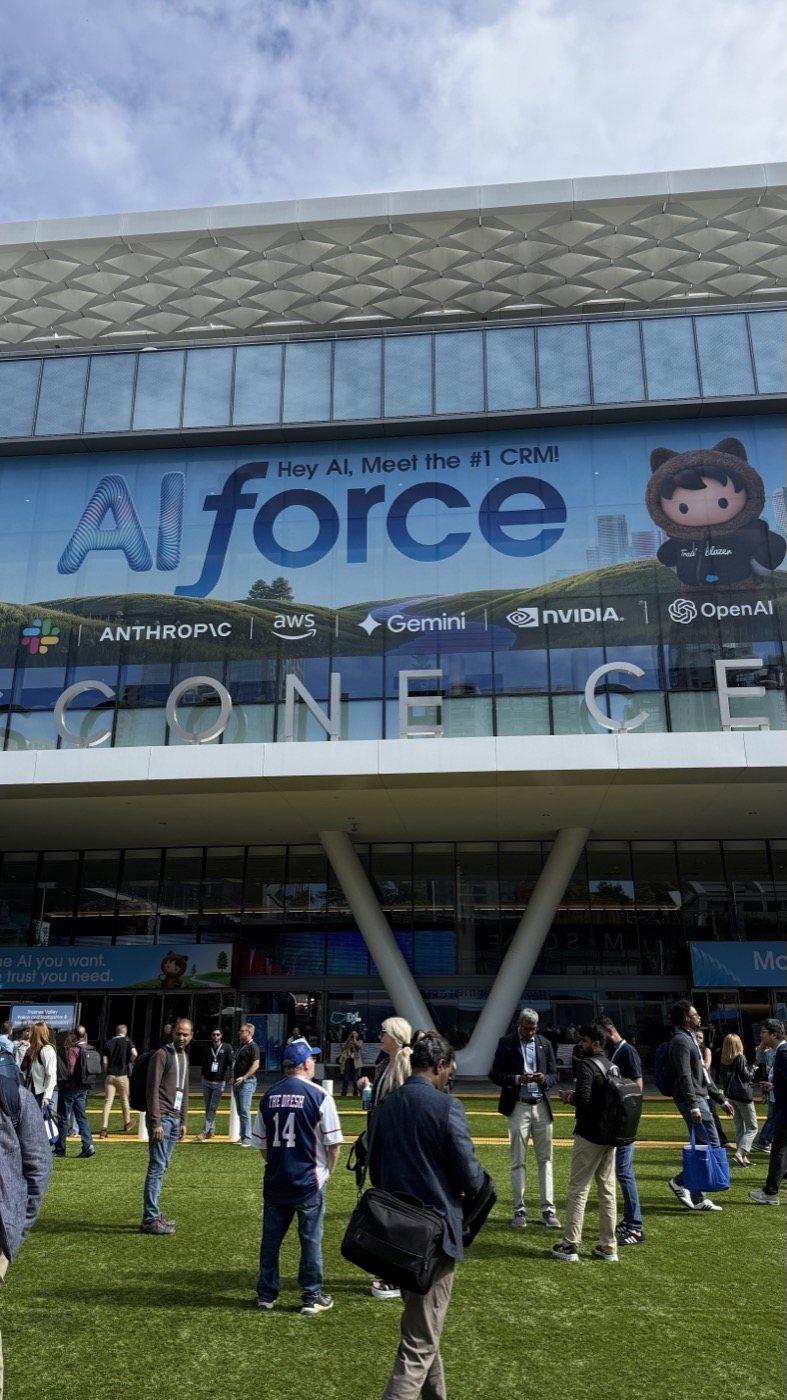
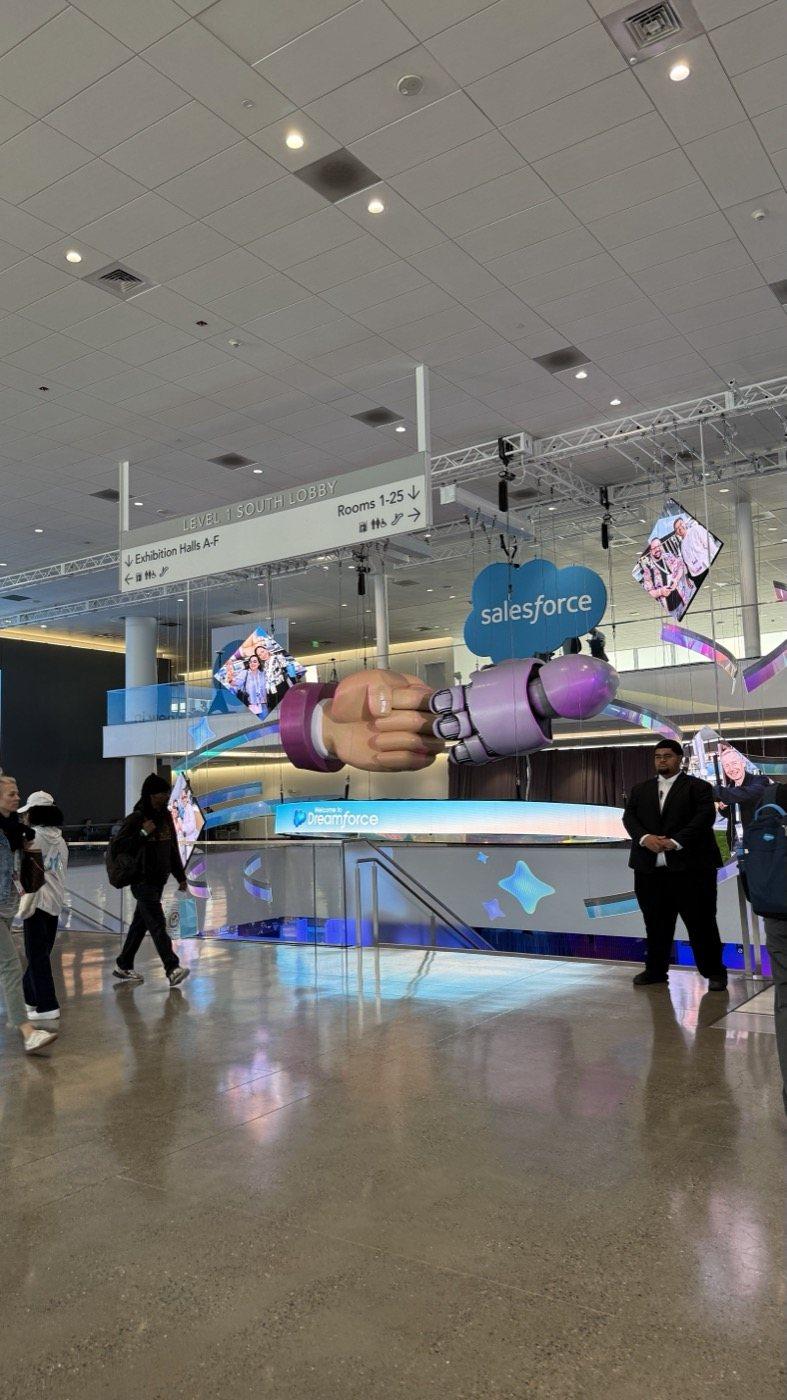
Dreamforce ran from 15 to 17 September 2026 at Moscone Center under the theme “Becoming an Agentic Enterprise”, with over 1,600 sessions and more than 50 keynotes according to Salesforce’s own programme.
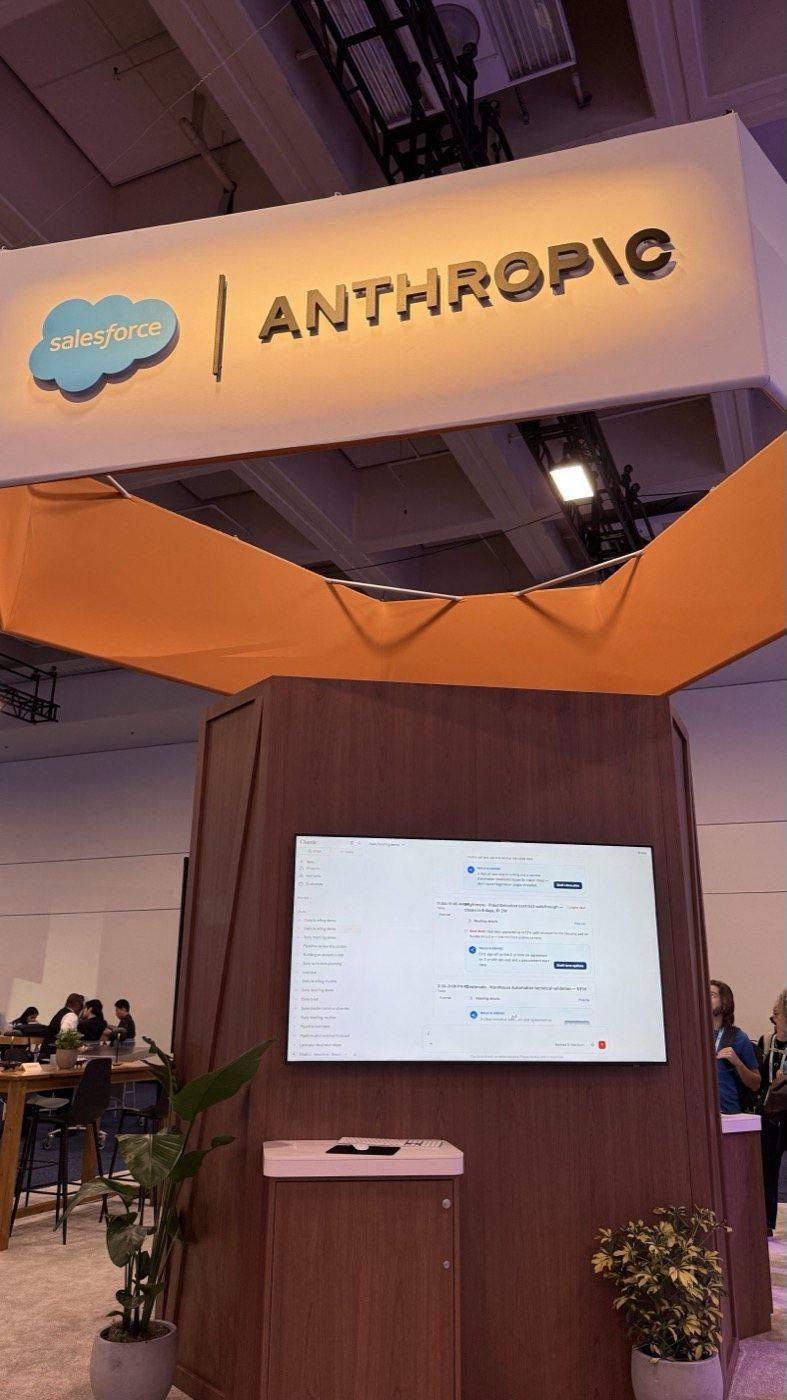
The headline was AIforce, a “live interface layer” that carries Salesforce data, workflows and permissions into Claude, Slack and other tools. Salesforce also announced Koa, its first CRM reasoning model, built with NVIDIA, plus Agentforce Coworker and seven ready-to-deploy agents named Casey, Fin, Paige, Carter, Hunter, Marshall and Piper. Partnerships with Google Cloud, AWS, Siemens and Anthropic were announced alongside.
Marc Benioff called it “an interface revolution”. Patrick Stokes, President of Applications and Marketing, said the value “has never been in the UI. It’s been in the platform that stores the way our customers encode their business.” Co-founder Parker Harris put the same idea as a question: “why should you ever log into Salesforce again?”
In the main keynote on 15 September, Benioff said over 30,000 customers are on Agentforce, cited “7 billion AWUs”, and said Salesforce is “entering into the $50 billion in revenue” next year. No new Agentforce pricing was announced, according to the gptfy.ai recap.
What the keynote actually claimed
The numbers the pre-event material lacked were in the keynote on 15 September 2026. Benioff dismissed six months of SaaS apocalypse talk as “crazy nonsense” and answered it with revenue: “we spent just two years now in the 40 billions in revenue. And next year, we’re entering into the 50 billions in revenue.” He cited second-quarter guidance of “46.4 billion in revenue”, “another billion dollars in free cash flow, 14% CRPO growth”, and “our lowest customer attrition ever, our longest customer contracts ever”.
The agent proof was Salesforce running Salesforce. Benioff said the Hunter agent “generated $500 million of pipeline for me last quarter”, that Casey “answered five million customer service issues” in around 18 months, and that Fin, the newly acquired customer agent, went live on help.salesforce.com “in about 12 days”. He put Agentforce at over 30,000 customers.
Pressed from the stage on why anyone should ever log into Salesforce, he defined what the company sells: “our product is the trust that all of you, our customers, put in us to hold your data, to hold your workflows, your business processes, your permissions, your security rules.”
Patrick Stokes then demoed AIforce built on Claude, with a live pipeline view reading “$8.2 million short of your $285 million target with three weeks left to run” and a Slack message drafted by Claude. His own gloss on the flourish: “I asked Claude to code in a sad trombone.” Dario Amodei of Anthropic told the room that even if the technology were frozen today, “we’re making use of maybe only five or 10% of what the possible value of the technology is”.
Two figures on that stage would survive a procurement review. Adecco CEO Denis Machuel said his recruiters “saved 35, 40% of their time” and the company has “placed 20,000 more people year to date”, with Salesforce putting Adecco’s candidate work at “2.6 million agent interactions” this year. Siemens’ Roland Busch said 120,000 suppliers and 65,000 partners run through Salesforce, with Teamcenter as the product backbone. Every other number described Salesforce’s own agents working on Salesforce’s own business, which is evidence of conviction rather than evidence of return.
The boards on the 101
The pricing of the city’s attention is public. The San Francisco Standard reported on 3 August 2026 that the biggest signs on US 101 cost “$200,000 to $250,000 a month”, per Eric Perko of Apollo Partners, up 20 to 30% on pre-pandemic rates, and that nearly all of them are leased by AI, tech and finance companies. The same piece put the daily flow into the city across the Bay Bridge at more than 100,000 people.
The saturation was a running joke inside Moscone. On the MuleSoft keynote stage, titled “From AI to ROI with Agent Fabric”, a speaker said “here in San Francisco, every single billboard you walk by is basically screaming at you about AI”.
Austin Hughes of Unify wrote up the drive on LinkedIn during the same week: boards reading “AI that generates ROI!”, “Hire AI not humans!”, “Hire humans not AI!”, “The future is AI!” His conclusion was blunter than anything on the boards. “Most B2B marketing just isn’t good.” Unify put $100,000 into its first San Francisco campaign in September and aimed, in his words, to “look more like a streetwear brand than an AI company”.
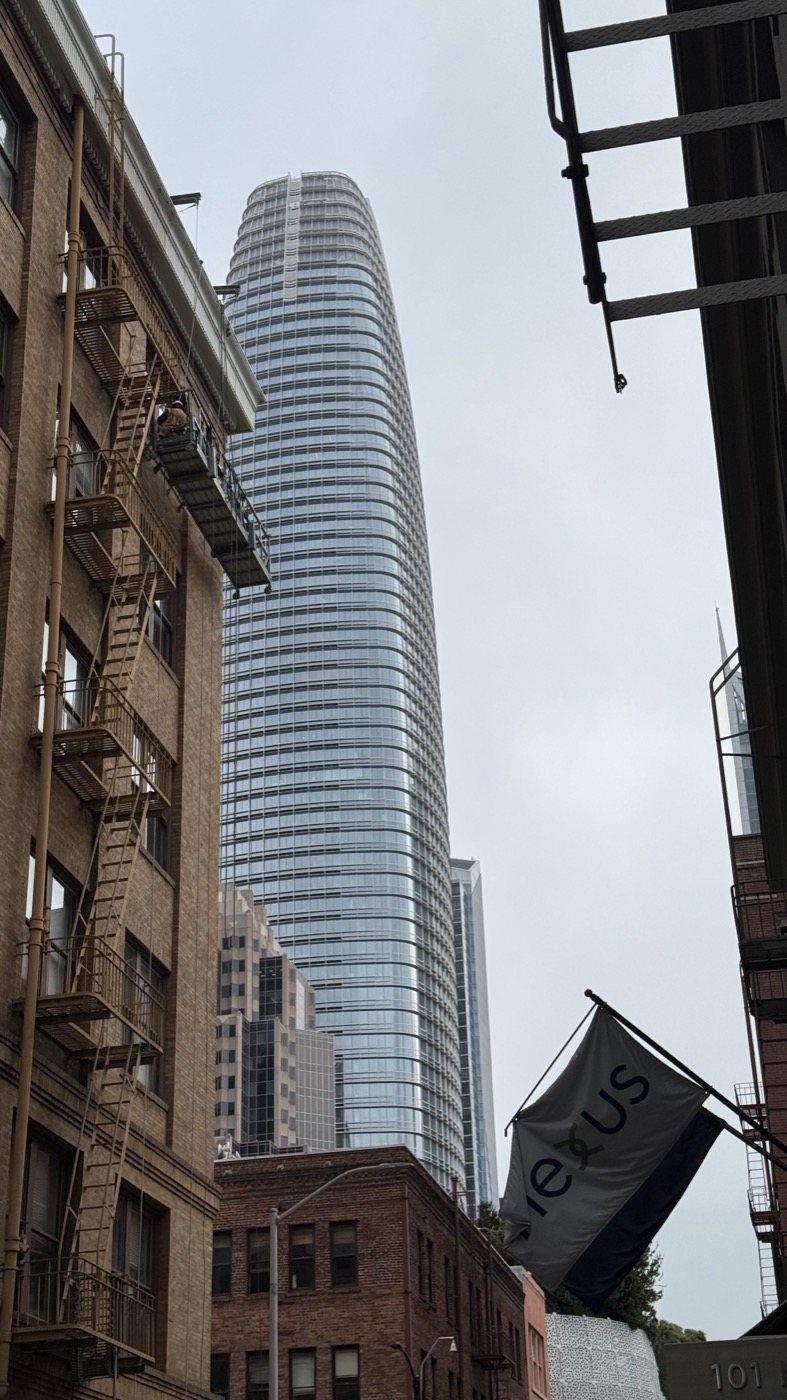
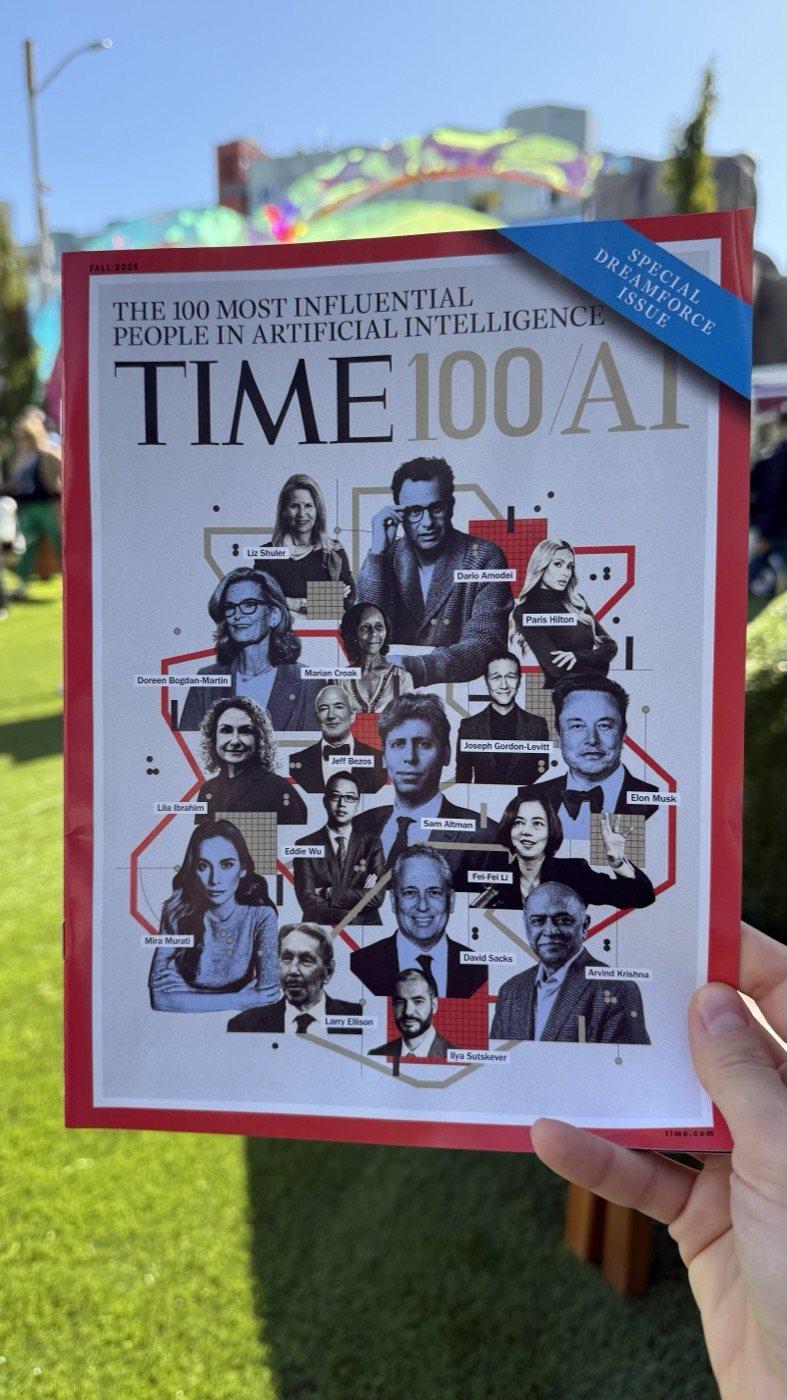
An estate lawyer bought a board and won the week on budget
The sharpest piece of out-of-home in the city was not sold by a technology company. Estate lawyer Susanna P. Lichter bought a billboard reading “This is not an AI billboard. Prepare to die.”, placed next to a sign for an “AI canvas” startup. The San Francisco Standard covered it on 9 September 2026 and the ABA Journal followed on 10 September.
Her read on the neighbouring creative was precise. “Some people find them dystopian. Others can’t parse them at all. My billboard is saying something that everybody can understand, which is that you’re going to die.”
The arithmetic was the part I wrote down. She told the Standard the board costs under $5,000 for four weeks and her flat fee for an estate plan is $4,000, so the campaign pays for itself in 1.1 clients. Nobody needs a model to check that.
The hearses
Crosby ran a campaign headlined “In Memoriam: The Billable Hour, 1913-2026.” During Dreamforce week the company drove a convoy of hearses around San Francisco. Billy Gallagher of Crosby set out the logic on LinkedIn: “our custom agents have enabled our barred attorneys to review contracts so quickly that we no longer need to bill by the hour. So we’re happily saying goodbye to an outdated business model and hello to a new age: predictable, upfront fees per document.”
The company behind it is small and specific. Forbes reported on 31 March 2026 that Crosby is New York-based, co-founded in September 2024 by CEO Ryan Daniels, a former in-house counsel at AI startups, and John Sarihan, formerly an engineering manager at Ramp. It had about 100 client companies including Cursor and Runway. Its agents review contracts in hours, a human lawyer does the final check, and the client is billed by the contract. Lux Capital’s Brandon Reeves co-led the round. Daniels told Forbes: “This is I think the most dramatic change for lawyers in a hundred years.”
Read that campaign as marketing and it is a position rather than a product claim. A hearse states one thing the buyer already understands before reading a single word. The date on the tombstone, 1913 to 2026, makes an assertion you can go and check. And the target is the category’s business model, not the company’s feature list, which is the difference between a claim about yourself and a claim about the category.
The ROI board
On the afternoon of 16 September 2026 I photographed a box truck parked beside a bike lane in downtown San Francisco. The side panel was red, three words in white capitals, “BIG AI ENERGY”, with the CloudZero logo above them. The rear panel was white and carried the actual claim: the logo again, and the line “The AI ROI Company”, with “AI ROI” picked out.
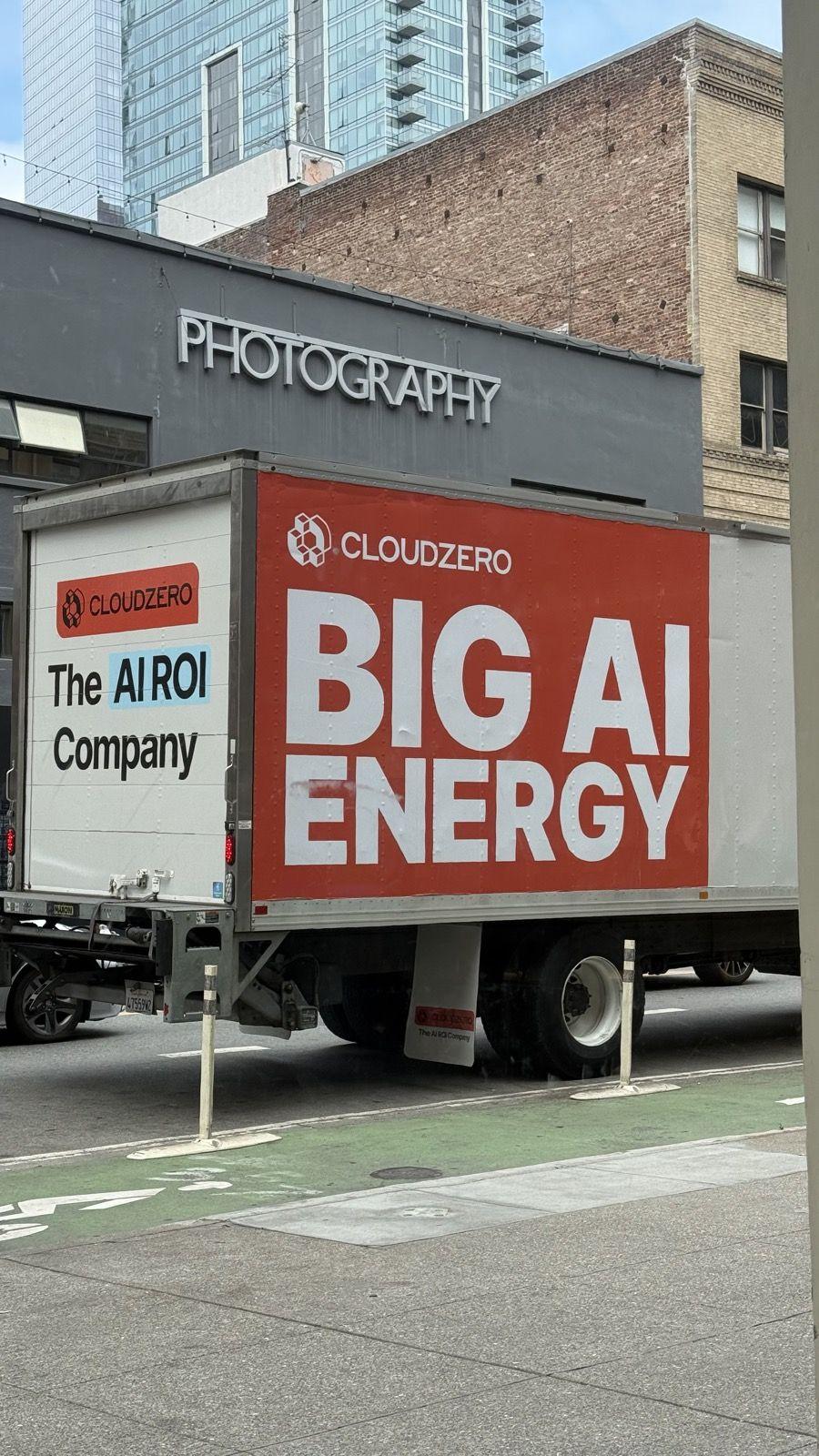
The genre was the week’s house style. One Agentforce keynote was titled “From Fast Start to Real ROI”. MuleSoft’s was “From AI to ROI with Agent Fabric”, and on that stage a customer executive said “You can’t really just put money into AI and measure the return on AI.” Austin Hughes’s tally of boards on the 101 included “AI that generates ROI!”
The truck is a different order of claim. It does not promise to generate return. It claims a category name and sells the instrument that measures return, which is far harder for a procurement officer to argue with.
It also survives the test this piece keeps applying, because a buyer who types the line into an assistant lands on a page. CloudZero, a Boston company, issued a release on 28 May 2026 headed “CloudZero, The AI ROI Company, Launches the Financial Control Plane for AI”, describing “a shared system that finance, IT, and engineering teams use to connect every dollar of AI spend to business outcomes in real time”. The release cites Gartner putting enterprise AI spending at $2.6 trillion in 2026 and growing 47% annually. It also states that “only 14% of CFOs report clear, measurable ROI from their AI investments, and 80% of companies miss AI spend forecasts by 25% or more”, citing CFO.com and a Mavvrik report for the two figures. It names Coinbase, Klaviyo, Miro, Nubank and Rapid7 as customers, and the company’s site says it is “Managing over $14B in spend”.
So the highway ran in three tiers. The hearse was a position, and a position needs no page. CloudZero was a category claim with a page behind it: the joke on the side panel bought the attention, the rear panel made the claim, the release held the proof. Most of the rest was a promise with nothing behind it, which is what MarketScale had flagged before the doors opened when it noted the pre-event material carried almost no customer-reported ROI figures.
The bus that said it plainly
Early that evening I photographed a Muni bus going through downtown wrapped in a Profound advertisement. One line ran the length of the side, ending “…engineers use Profound”, with the first word cut off in my frame. Underneath it: “Control what AI says about your brand.”
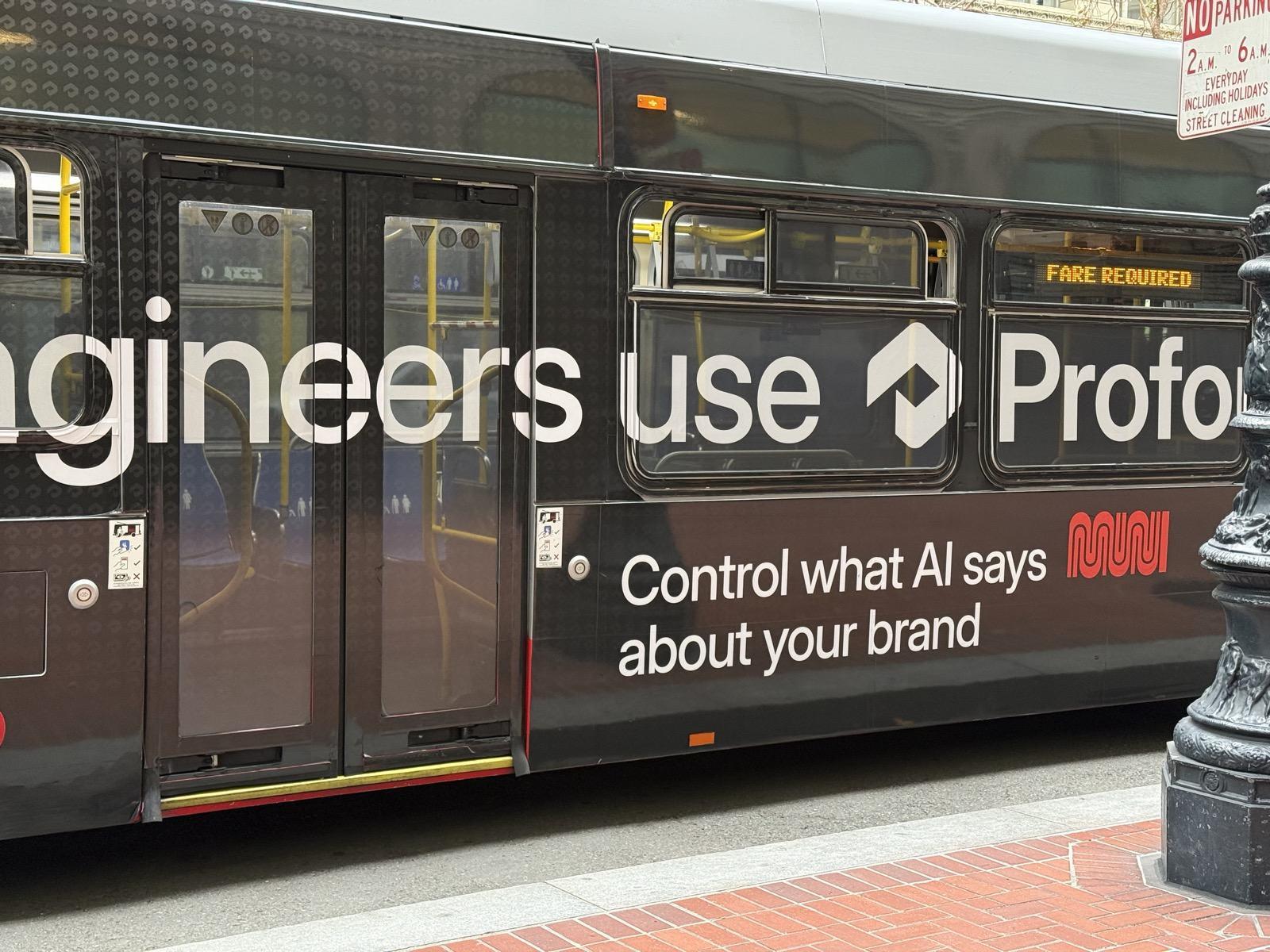
That is the buyer’s problem stated as the buyer experiences it, rather than a product feature.
Profound is an AI visibility platform founded in New York in August 2024 by James Cadwallader and Dylan Babbs, and it monitors how systems including ChatGPT, Gemini, Perplexity and Copilot describe and recommend brands, per the Technotize profile. On 15 September 2026, the first day of Dreamforce, the company announced a $180 million Series D at a $1.8 billion valuation, co-led by Sequoia Capital and Kleiner Perkins, saying in the same release that the platform is used by “16% of the Fortune 500” and is “built on 2B+ real user prompts”. Technotize records the Series C at $96 million on a $1 billion valuation in February 2026.
Profound put the thesis in its own August 2025 Series B release: “We’re entering a ‘zero-click world’ where AI conversations become a consumer’s first impression of your brand.”
A bus wrap funded at that valuation is the market confirming the category rather than arguing for it. The instrument is now purchasable. Deciding what a company should be known for when the assistant answers, and building the evidence that makes the answer hold, stays a human decision, and no dashboard makes it for you.
What this means for a B2B brand
The gap between those two campaigns is the gap between attention and retrievability. Attention is purchasable at $250,000 a month on the 101, per Apollo Partners’ figures in the Standard. Being the name a buyer’s assistant returns first is earned by publishing the definitions, numbers and named cases that the assistant can find and quote.
The split we work to is simple. People decide the position, because a hearse convoy is a judgement call no system will make for you. A system runs the execution, because keeping proof current across a category takes maintenance rather than inspiration.
Lichter’s board carried a claim anyone could check in one sentence. Crosby put a date on the thing it was killing. The rest of the highway asked for trust and left nothing behind for the buyer to check at two in the morning, which is when institutional buyers actually check.
FAQ
Does out-of-home work for B2B, or is it brand theatre?
It works when the board carries a position the buyer can repeat without a slide. Susanna P. Lichter’s estate-planning board cost under $5,000 for four weeks against a $4,000 flat fee, so it needed 1.1 clients to break even, per The San Francisco Standard. The failure mode is spending $200,000 a month, the top-of-market rate Apollo Partners gave the Standard, on a claim nothing supports.
Our positioning is built on ROI. How do we make it survive the buyer’s AI assistant?
Publish the evidence in retrievable form before you buy the media. Named customers, dated figures, the method behind the number, the cost to run in production. MarketScale’s criticism of the pre-Dreamforce material was that procurement, security and operations “can’t approve an agentic rollout on positioning alone”. Assume the assistant is asked for your numbers and answer with what it will find.
We are regulated and cannot say anything as blunt as “the billable hour is dead”. What is the alternative?
Attack a practice instead of a competitor. Crosby’s claim was about a pricing model dated 1913 to 2026, not about a rival firm. A regulated brand can name the convention it refuses, put a date on it, and let the buyer draw the comparison. Compliance objects to unprovable superlatives far more often than it objects to a clear position.
Sources
- Salesforce, Dreamforce 2026 main keynote, YouTube, 15 September 2026
- VALiNTRY360, Dreamforce 2026 recap, 18 September 2026
- Cloudsheer, Dreamforce 2026 recap
- Cloud Odyssey, Dreamforce 2026 recap
- gptfy.ai, Dreamforce 2026 recap
- MarketScale, pre-event analysis, Dreamforce 2026
- The San Francisco Standard, "One billboard, $3M a year", 3 August 2026
- The San Francisco Standard, "Prepare to die", 9 September 2026
- ABA Journal, 10 September 2026
- Austin Hughes, Unify, LinkedIn, September 2026
- Billy Gallagher, Crosby, LinkedIn, Dreamforce week 2026
- Forbes, Rashi Shrivastava, 31 March 2026
- LawFuel, Crosby coverage
- CloudZero, "CloudZero, The AI ROI Company, Launches the Financial Control Plane for AI", 28 May 2026, and cloudzero.com
- Profound, Series D press release, 15 September 2026
- Profound, Series B press release, August 2025
- Technotize, Profound company profile

Anne leads content, strategy and SEO across the Brave New client roster.